

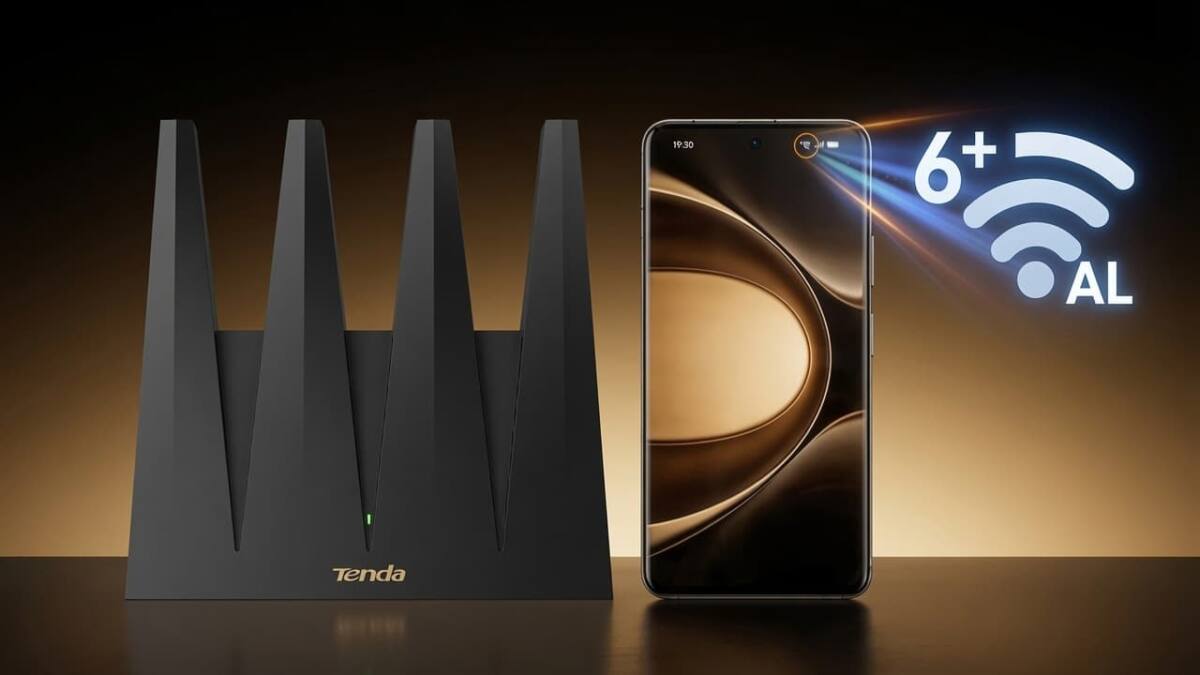
Tenda has launched the AX3000 Vertical Little Taishan, a compact Wi‑Fi 6+ router that pairs gigabit networking with a starting price of 159 yuan, or as little as 139 yuan during promotions. That works out to about $20, which is the sort of number that makes the usual ”budget router” label sound a bit lazy.
The new AX12 is built in a vertical form factor, much like Tenda’s Taishan-series routers, and includes four adaptive gigabit Ethernet ports, plus large ventilation openings. In a category where too many cheap routers still look and feel like overheated plastic afterthoughts, the taller chassis is a practical choice rather than a design flourish.
Wi‑Fi 6+ features on the AX12
Tenda says its Wi‑Fi 6+ technology improves wireless performance at the chip level, and compatible phones can identify the network as Wi‑Fi 6+. The router also uses a 5 GHz antenna rated at 7 dBi, which Tenda says delivers about 40% more gain than conventional 5 dBi antennas.
That’s backed by two external independent FEM modules and a dual-core 1.2 GHz processor. The company claims the processor delivers 20% more computing power than similar products, which should help when several devices are fighting for airtime and nobody wants the video call to turn into modern art.
160 MHz support and 2976 Mbps dual-band speed
The AX3000 Vertical Little Taishan supports 160 MHz channel width and is rated for simultaneous dual-band speeds of up to 2976 Mbps. That puts it squarely in the ”fast enough for most homes, cheap enough to be tempting” bracket, especially at a launch price that undercuts many better-known Wi‑Fi 6 routers.
- Model: AX12
- Wireless standard: Wi‑Fi 6+
- Ports: four gigabit Ethernet ports
- 5 GHz antenna gain: 7 dBi
- Channel width: 160 MHz
- Top dual-band speed: 2976 Mbps
A cheap router that borrows a familiar playbook
The bigger story here is how aggressively Chinese networking brands are pushing feature-rich routers into low-price territory. Huawei has spent years making the ”Wi‑Fi 6+” badge part of the consumer conversation, and Tenda is clearly trying to win buyers with the same formula: more antennas, more speed, more ports, less money.
Whether that translates into real-world performance will depend on how well the hardware holds up under load, but the spec sheet is unusually generous for the price. If Tenda can keep this kind of configuration near the $20 mark, rivals will have to answer with either sharper discounts or simpler models that suddenly look a lot less persuasive.