

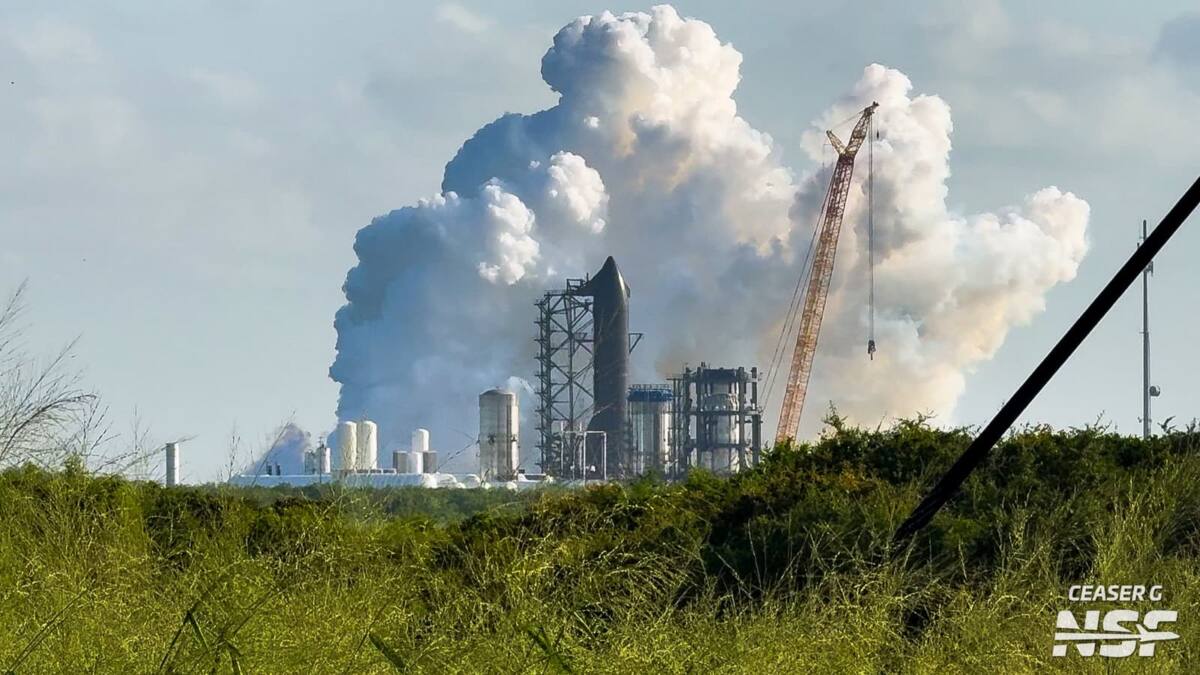
SpaceX has pushed its next Starship test flight a step closer after lighting a new upper-stage prototype for the first time. Ship 40 completed a static fire at Massey’s Test Site in Starbase, with one engine firing briefly after a rapid fueling sequence, a sign the company is moving through the usual pre-launch choreography with very little wasted time. The test puts Starship Flight 13 one step closer.
The burn lasted about 10 seconds and produced the sort of dramatic exhaust cloud SpaceX fans live for and everyone else politely tolerates. More interestingly, the test appears to have focused on a single engine and may have simulated an in-space relight, which is one of the tougher tricks Starship still needs to prove before the vehicle can do much more than make noise.
Ship 40 moves into Starship Flight 13 prep
Ship 40 is expected to serve as the upper stage for Flight 13 alongside Booster 20. Gwynne Shotwell has said the mission will largely follow the Flight 12 script, which is classic SpaceX: repeat the pattern, fix the weak points, then attempt something harder. That approach has turned Starship testing into a sort of high-altitude factory line, and it is usually faster than the alternative – which is waiting around for perfection.
- Vehicle: Ship 40
- Location: Massey’s Test Site, Starbase
- Test type: static fire with one engine
- Engine burn: about 10 seconds
- Timing: roughly 20 minutes after fueling
Why a short engine test still matters
A brief static fire is not the same thing as a launch, obviously, but it does tell SpaceX whether the plumbing, ignition sequence, and ground systems are behaving themselves. That matters because Starship is now less about spectacular prototypes and more about operational repetition: the company wants each step to look boring until the day it is not.
The broader race here is also getting tighter. While SpaceX continues testing Starship hardware in Texas, work is advancing on the launch tower infrastructure at Cape Canaveral in Florida, where Mechazilla assembly has already started. If Flight 13 goes to plan, the next question is whether Flight 14 becomes the first orbital mission – and whether the hardware can keep up with the ambition.