

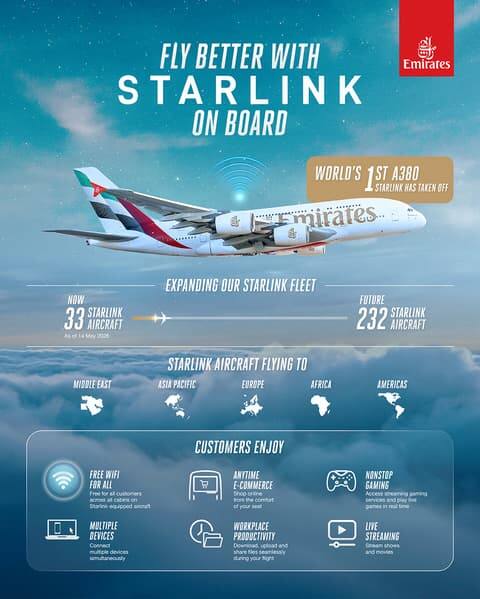
Emirates has put Starlink on the first Airbus A380 in its fleet, turning the world’s biggest passenger jet into a flying Wi‑Fi hotspot with free internet in every cabin. The rollout is a public flex from both Emirates and SpaceX: one airline wants faster, better onboard connectivity; the other wants its satellite internet on the most conspicuous aircraft type in commercial aviation.
Elon Musk even reposted Emirates’ announcement, which is a neat reminder that aviation internet is now part product launch, part status symbol. For passengers, the pitch is simple: video streaming, real-time gaming, multiple devices at once, online shopping, and normal work emails without the usual altitude-era suffering.
Emirates says it now has 33 aircraft equipped with Starlink and plans to grow that number to 232. The aircraft are already flying across the Middle East, Asia-Pacific, Europe, Africa, and the Americas, so this is not a laboratory demo; it is a wide deployment on a network that covers most of the routes where premium passengers will notice the difference most.
What Emirates is promising onboard
- Free Wi-Fi for all passengers in all classes
- Video streaming and real-time gaming
- Multiple devices connected at the same time
- Online shopping and regular work use during the flight
The timing also fits a bigger airline trend. Long-haul carriers have spent years selling ”connected cabin” upgrades, but many systems still feel like expensive, half-working compromises. Starlink’s pitch is more aggressive: low-latency satellite internet that can support the kind of usage passengers already expect on the ground, not just basic messaging.
The Boeing 777 rollout started first
Emirates said it began fitting Starlink on Boeing 777 aircraft in November 2025 and expects the full rollout to be complete by the middle of 2027. The airline frames the work as part of a $5 billion fleet modernization program, which tells you this is not a side project tacked onto a press release. It is a bet that better internet will help justify premium fares and keep frequent flyers from noticing the seat belt sign quite as much.
The A380 is the headline grabber because it is the most dramatic possible showcase for the service, but the real story is scale. If Emirates can make Starlink work across a mixed widebody fleet and multiple regions, other airlines will have a harder time selling slower, more fragile inflight Wi-Fi as good enough. The next question is whether passengers start expecting this level of connectivity everywhere, or whether ”free” simply becomes the new baseline.