

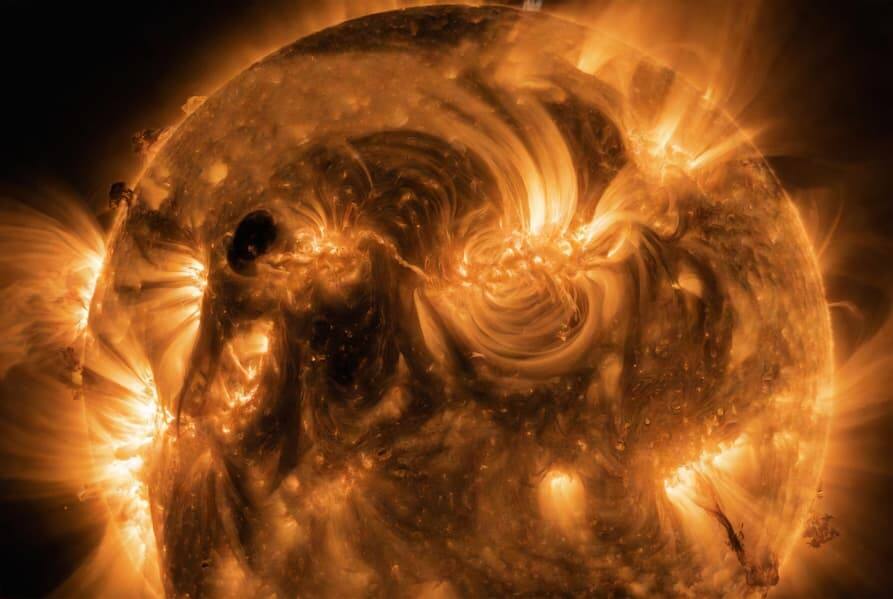
A giant cluster of sunspots has appeared on the far side of the Sun, and it is already being compared with one of the most violent active regions seen in recent years. Solar Orbiter is tracking the solar active region from the side of the star hidden from Earth – a useful reminder that the Sun does not stop brewing trouble just because we cannot see it yet.
Researchers from the Laboratory of Solar Astronomy at IKI and ISEF say the area is comparable in size to region 3664, which triggered the strongest geomagnetic storm in 20 years in May 2024. That comparison alone tells you this is not just another patch of sunspots for the astronomy wallpaper crowd.
Why large sunspot groups get attention fast
Big sunspot groups are where the Sun tends to cash out its magnetic debt. The larger the active region, the more magnetic energy can build up, and that raises the odds of powerful flares and plasma eruptions. In plain English: a large sunspot group matters, and this one is big enough to make space weather forecasters pay attention.
That does not mean Earth is in the firing line right this minute. The region is still on the far side of the Sun, so there is no direct impact yet. But as the star rotates, the area may move into view, and if it keeps its scale and activity, satellites, radio links, and power grids could all feel the squeeze.
What Solar Orbiter is seeing now
Solar Orbiter’s job is to give scientists a look at what Earth-based observatories cannot see. That matters because some of the most disruptive solar events start out of sight and only become obvious when the damage is already on the way. Europe’s and the US space agencies have spent years building toward better solar warning systems for exactly this reason: the Sun is much less dramatic when it has the courtesy to warn you first.
- Object: a giant sunspot group on the Sun’s far side
- Observer: Solar Orbiter
- Benchmark: region 3664 in May 2024
- Potential effects: magnetic storms, satellite issues, communications disruptions, and grid stress
The next few days will decide the story
The real question is whether this active region stays compact and energetic as it turns toward Earth, or starts to fade before it reaches the front side of the Sun. If it holds together, space weather watchers may get another reminder that the star at the center of our system is perfectly capable of ruining a calm week without asking permission first.