

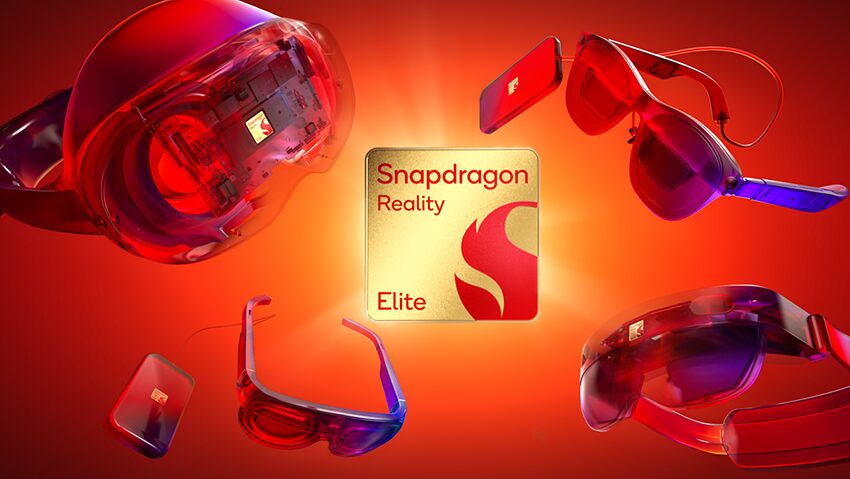
Qualcomm has a new answer to one of XR’s oldest problems: how to cram serious AI and graphics into something you can comfortably wear for hours. The Snapdragon Reality Elite is its latest flagship platform for smart glasses and standalone headsets, and the headline numbers are loud enough to get attention: up to 60% better GPU performance, a 30% faster CPU, 48 TOPS of AI power, and temperatures as much as 12°C lower under load.
Compared with the Snapdragon XR2+ Gen 2, the new Snapdragon Reality Elite also promises up to 20% longer battery life. Qualcomm is betting that better efficiency, more local AI, and cooler operation can finally make spatial computing feel less like a science project and more like a product category people keep on their face for more than 20 minutes.
Snapdragon Reality Elite specs and performance claims
Compared with the Snapdragon XR2+ Gen 2, the new chip promises gains that should matter in real use, not just on slides, which is usually where chipmakers like to hide their optimism.
- Up to 60% better GPU performance
- 30% stronger CPU
- 48 TOPS Hexagon NPU, up 160%
- Up to 20% longer battery life
- Up to 12°C cooler under load
The AI jump is the real story here. Qualcomm says the upgraded Hexagon NPU is built to run heavier large language models and large vision models directly on-device, which should cut latency and reduce dependence on the cloud. That opens the door to faster contextual assistants, photorealistic avatars, and computer vision that reacts in the moment instead of after the moment has passed.
Displays, ray tracing, and mixed reality quality
On the visual side, Reality Elite supports displays up to 4.4K per eye at 90Hz, along with hardware ray tracing and improved video see-through quality. That last part is especially important for mixed reality, because blending digital objects into the real world still falls apart quickly if passthrough looks muddy or laggy. In other words, the specs are not just about pretty numbers; they are about making the illusion hold together.
The platform is designed for both all-in-one headsets and lighter tethered or split-compute devices inside the Android XR ecosystem. That gives Qualcomm and its partners some flexibility, which matters because the category is still split between bulky self-contained headsets and glasses that offload processing to a separate puck or companion device.
First devices and Qualcomm’s START program
The first products using the platform are expected later in 2026. Among the early adopters, XREAL’s Project Aura glasses use a dual-chip setup with a compute puck, while Play for Dream is also building an immersive device around the new silicon.
Qualcomm is also rolling out Snapdragon START, a toolkit with reference designs and support intended to help brands ship AI-powered smart glasses and personal AI wearables faster. That is a fairly direct signal that Qualcomm wants to be the plumbing behind the next wave of consumer AI devices, not just the parts supplier for a niche headset market.
The bigger question is whether this is enough to move XR beyond early adopters. Better chips solve heat, battery life, and latency, but they do not magically fix content gaps or convince people to wear headsets for fun. Still, if Qualcomm’s efficiency claims hold up in real devices, 2026 could be the first year XR wearables feel less like prototypes and more like something mainstream buyers might actually consider.