

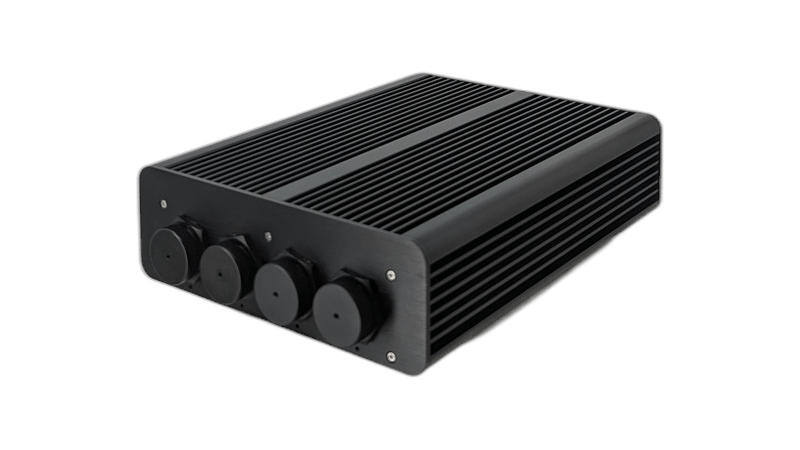
Silent PC has started selling one of the strangest Ryzen 9000 desktops you can buy: a fanless, sealed machine built for places where ordinary PCs would fail fast, from dusty factory floors to boats and open-air vehicles. The Silent PC IP65 Ryzen 9000 desktop starts at $3350, which is a lot to pay for a computer that has no active cooling, no front USB ports, and no audio jacks – but that is also the point. It is a niche system built for harsh environments, not for bragging rights in a gaming rig thread.
The headline feature is the case itself. Silent PC uses a fully sealed IP65 chassis that doubles as the cooling solution, turning the enclosure into a giant heat sink. That design avoids fans entirely, which helps with reliability, dust resistance, and water protection, but also limits how much sustained power the chip can deliver before throttling kicks in. In other words: clever engineering, yes; infinite performance, no.
Silent PC IP65 Ryzen 9000 desktop specs
The entry model ships with an AMD Ryzen 5 9600X, an ASRock X600-ITX Thin Mini-ITX motherboard, 32GB of Crucial DDR5-5600 SO-DIMM memory, and an NVMe SSD. For an extra $165, buyers can move up to a Ryzen 7 9700X, which is a modest upgrade in the context of a system already priced like specialized industrial hardware. The machine does not include a discrete graphics card, which keeps things simpler but also narrows the use cases pretty quickly.
- Starting price: $3350
- Base CPU: AMD Ryzen 5 9600X
- Optional CPU upgrade: Ryzen 7 9700X for $165 more
- Memory: 32GB Crucial DDR5-5600 SO-DIMM
- Storage: NVMe SSD
Where a sealed PC makes sense
This is not a consumer desktop trying to be odd for the sake of it. The pitch fits industrial and mobile deployments where dust, spray, and constant vibration are normal, and where a fan can become the first thing to fail. Similar fanless systems have existed for years in automation and transportation, but pairing that approach with a current AMD Ryzen 9000 chip makes the package feel more ambitious – and more expensive – than the old embedded-PC stereotype.
The catch is obvious: thermal headroom. Silent PC says these fanless configurations have power limits, and long all-core workloads should not be expected to sustain full desktop Ryzen 9000 performance. For the right buyer, that trade-off is acceptable. For everyone else, a regular tower with air cooling will look wildly more sensible.
The real audience for this machine
Silent PC is basically selling a durability spec wrapped around a modern CPU platform. That is smart business, because customers who need IP65 protection care far more about uptime than about synthetic benchmarks. The open question is whether the company can turn this into a broader product line, or whether this remains one of those fascinating, highly engineered machines that gets attention precisely because almost nobody needs one.