

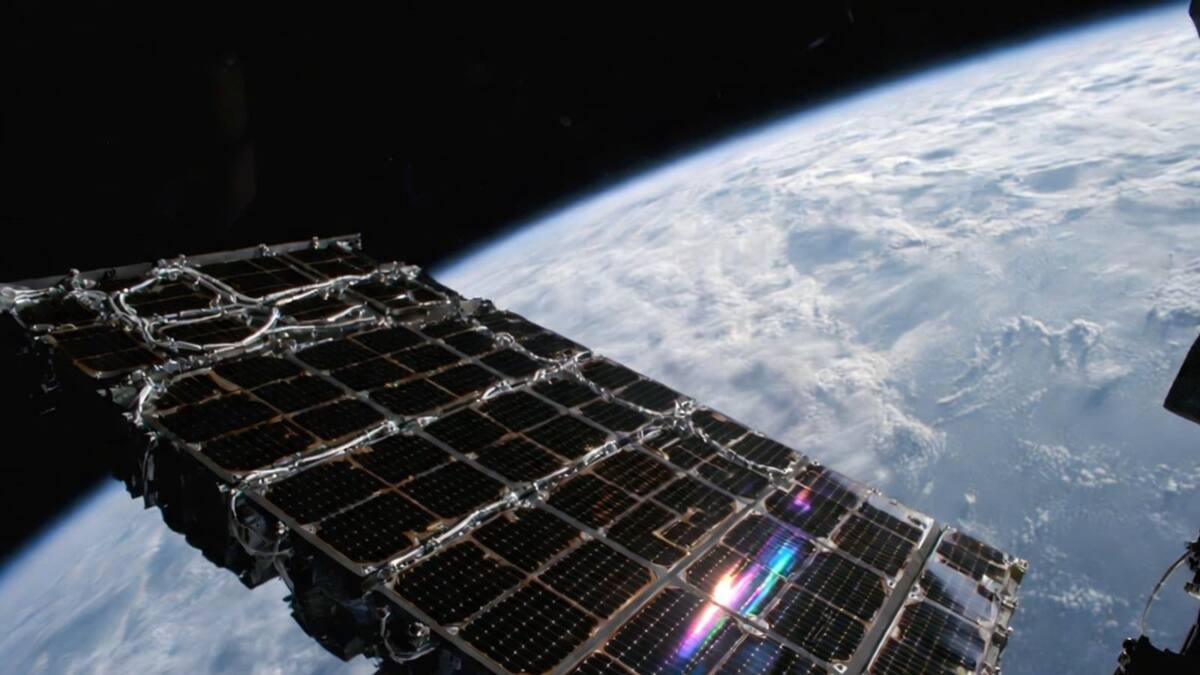
China’s Shenzhou-23 crewed spacecraft is headed for the country’s space station with nine scientific experiments on board, including a first-of-its-kind dynamic test of perovskite solar cells in orbit. The payload mix also includes continuous two-generation rice cultivation and a long-duration exposure study for nanozymes and actinomycetes.
The headline experiment is the perovskite work. Researchers will test both single-junction perovskite solar cells and perovskite-based tandem cells, trying to track how they age and fail in extreme space conditions. That matters because lightweight, flexible, high-efficiency panels are exactly what future low-orbit satellites, deep-space missions, lunar energy systems, and in-space manufacturing would like to have – ideally without the weight and cost penalties that make traditional hardware expensive to haul upward.
Perovskite solar cells face orbit conditions
Цан Хуайсин, a researcher at the Space Technology Center of the Chinese Academy of Sciences, said the experiment is meant to study how perovskite materials and devices evolve and what causes them to break down in harsh orbital conditions. That’s a sensible step: perovskites have been a favorite lab darling on Earth, but space is a far less forgiving sales pitch, with radiation, temperature swings, and vacuum all taking their turn at the problem.
In the same cargo batch, China is also sending samples for the first continuous two-generation rice experiment in orbit. Add in a five-month external exposure test with nanozymes and actinomycetes, and the mission starts to look less like a single research project and more like a compact bet on the future of space farming, materials science, and bioengineering.
Rice, nanozymes, and microbes in the payload
- Two types of solar-cell hardware: single-junction perovskite and perovskite-based tandem cells.
- First continuous two-generation rice cultivation in orbit.
- Five-month external exposure experiment for nanozymes and actinomycetes.
- Total mass of samples and devices: approximately 54 kilograms.
Nanozymes are artificial enzymes made from nanomaterials, while actinomycetes are unusual bacteria known for producing natural antibiotics. Packing those into one mission is a reminder that orbital science is increasingly about testing whether biology and advanced materials can survive outside the lab, not just whether they can be invented there.
The real question now is whether these experiments deliver useful durability data, or simply confirm that space is ruthless, which scientists already knew. If the results are good, China gets a stronger hand in the race for lighter spacecraft power systems and off-Earth life-support research; if not, at least the failure modes will be better understood, and in space engineering that is often half the victory.