

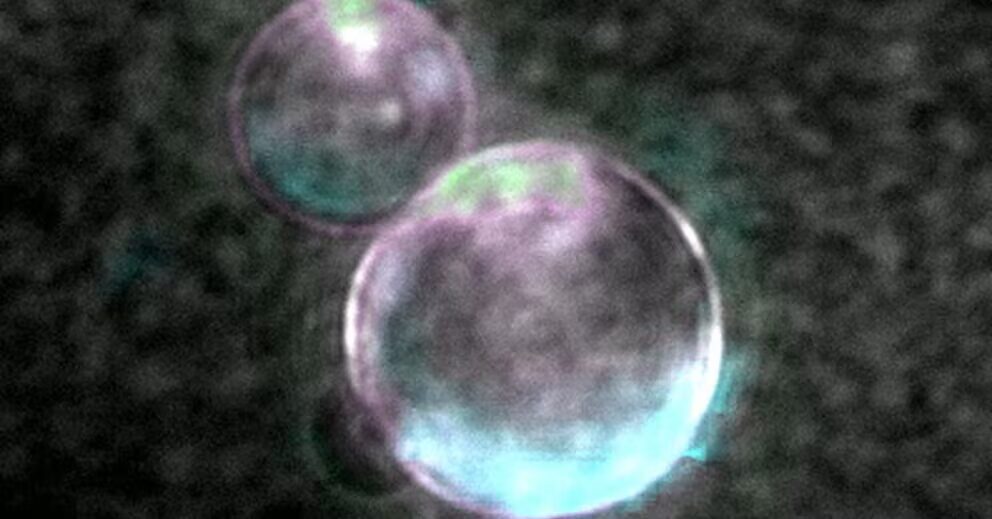
Researchers at the University of Minnesota have unveiled SpudCell, a synthetic cell made entirely from non-living chemical components that can grow, replicate its genetic material, and divide. This system is built from scratch without using an existing living cell as a base. Their findings, published as a preprint on bioRxiv, await peer review.
SpudCell’s standout feature is its unique approach to cell division. Most synthetic cell models rely on a cytoskeleton-a protein scaffold that maintains shape and aids division in living cells. The Minnesota team sidestepped this limitation: proteins accumulate on the membrane, generating tension that triggers division without needing a cytoskeletal framework.
The researchers describe SpudCell as completing nearly a full life cycle. It consumes resources, grows in size, copies its genome, and produces daughter cells. Under resource-limited conditions, faster-dividing variants outcompeted the original, demonstrating a rudimentary form of natural selection within the system.
How the synthetic SpudCell is built
The pursuit of minimal and synthetic cells is not new. Back in 2016, the J. Craig Venter Institute revealed JCVI-syn3.0, a bacterium with a minimized genome of 473 genes. While a landmark in synthetic biology, JCVI-syn3.0 was a pared-down version of a living cell rather than a creation from purely chemical components.
SpudCell’s creators emphasize their chemical-first approach. Their genome contains about 90,000 base pairs divided into seven DNA plasmids. By comparison, JCVI-syn3.0’s genome is roughly 531,560 base pairs. Though smaller, this difference highlights how far synthetic biology has come in trimming down essential functions, without implying SpudCell is superior.
This research represents a hybrid strategy at the interface of biology and engineering. Some teams focus on minimal cells derived from living bacteria, while others build protocells from liposomes and molecular modules. SpudCell aims to merge these paths: keeping engineering simplicity while adding features typically associated with living cells.
The design is modular-separating the genome into multiple plasmids lets scientists swap or modify parts without rebuilding the whole system. This flexibility is practical for labs, especially if the platform is adapted for tasks from protein synthesis to biomolecule testing.
Potential applications of the synthetic SpudCell
The team envisions SpudCell as a tool for applied synthetic biology, targeting processes where conventional industrial chemistry involves high temperatures, toxic reagents, and difficult purification. A stable, scalable synthetic cell could produce complex molecules under gentler conditions.
Potential uses include manufacturing novel drugs and materials, particularly compounds made with non-natural amino acids. These molecules are highly valuable in pharmaceuticals since they allow precise tuning of protein functions and can enhance drug stability-a long-standing goal in the field.
To further develop the platform, the researchers have launched the open Biotic Institute, granting outside teams access to its infrastructure. This collaborative model echoes successes in genome editing and cloud-based lab platforms, accelerating reproducibility-a key hurdle for bold biological claims beyond flashy press announcements.
The synthetic biology sector is no niche academic arena. Grand View Research projects the global synthetic biology market will exceed $70 billion by the early 2030s, driven largely by biopharma, agriculture tech, and industrial bioprocesses. The critical question is no longer ”can this synthetic cell be built?” but whether other labs can replicate SpudCell’s results and develop it into a dependable platform.
The emergence of SpudCell signals a shift towards fully synthetic cellular systems that blend engineering precision with life-like behavior. How quickly this approach can mature will shape synthetic biology’s future in medicine and manufacturing. Efforts to scale, stabilize, and harness synthetic cells for complex biochemical tasks will advance applications beyond simpler liposome-based protocells.