

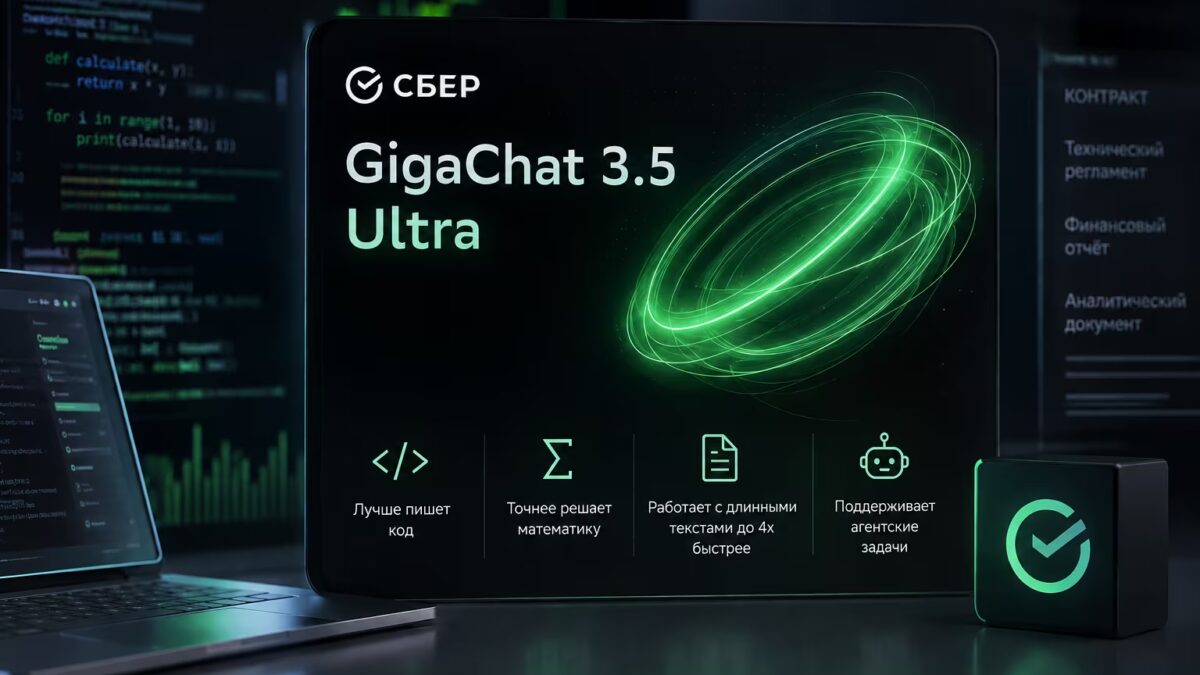
Sber has launched GigaChat 3.5 Ultra, now available for free use both personally and professionally. The company also released the model openly for developers, enabling integration into services and AI agents. Built on Sber’s proprietary architecture featuring linear attention, the model efficiently handles long texts without needing to reprocess entire contexts from scratch.
Sber reports that this new iteration is nearly twice as compact as its predecessor, demands fewer resources, and processes large documents up to four times faster. Internal tests show GigaChat 3.5 Ultra outperforming the previous Ultra version in programming, math, and Russian language query tasks. According to the company, the model now rivals the performance of leading open AI solutions on several key benchmarks.
GigaChat 3.5 Ultra’s faster long-text processing and compact design
This launch fits into a broader trend accelerating into 2025 and 2026, where AI developers weigh not just answer quality but also the cost and speed of handling extended context. Industry leaders like OpenAI, Anthropic, Google, and Meta are all working on similar challenges*. In Russia, competition between Sber’s corporate AI assistants and Yandex’s offerings is intensifying. Yandex is expanding its YandexGPT line across search, office, and cloud services, and for enterprise clients, speed and cost differences in processing documents are already measurable in rubles per query – especially critical in support, legal documents, and internal knowledge search.
Sber’s open access strategy to extend GigaChat adoption
Sber’s emphasis on open access to the model is strategic. Following Meta’s success with Llama* and rising interest around open models like DeepSeek, companies increasingly aim to embed AI not just through chat access but within developer infrastructure. For Sber, this is a bid to extend GigaChat’s presence beyond its own platform. How broadly GigaChat 3.5 Ultra will be adopted across corporate products and AI agents in the second half of 2026 remains an open question.
*Meta owns these technologies; however, Meta is designated as an extremist organization in Russia, and its activities are banned.