

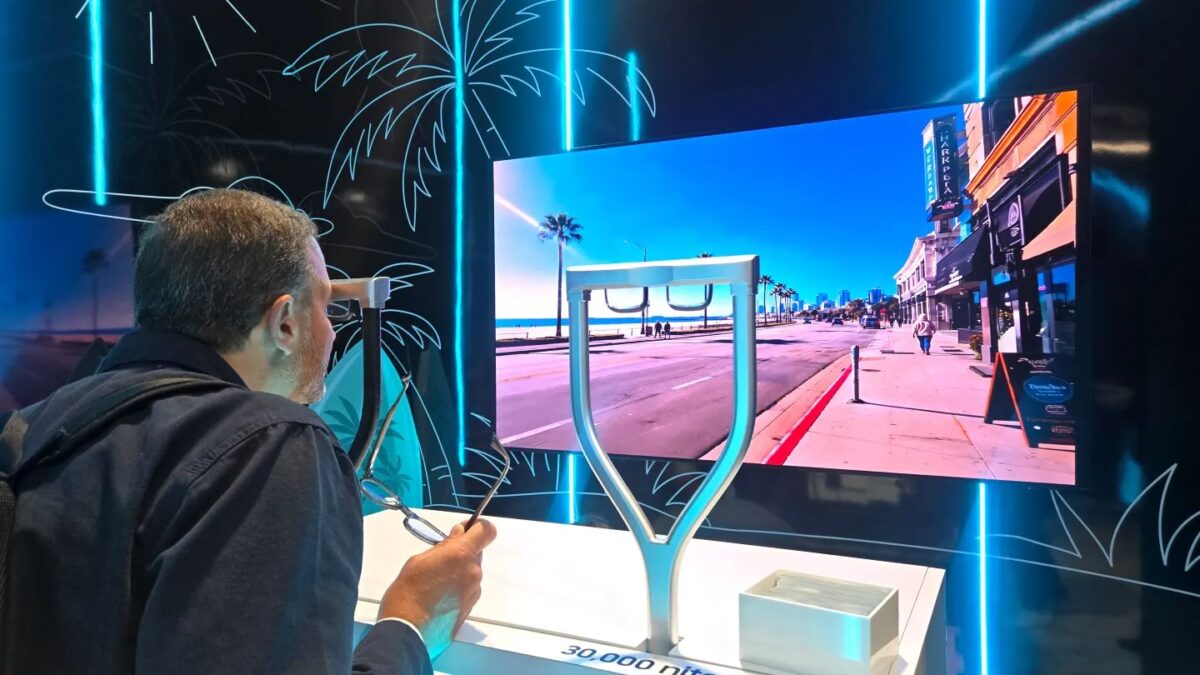
Samsung Display is betting that the future of AR glasses and mixed-reality headsets will be won on one painfully simple metric: brightness. At AWE USA 2026, the company showed a 1.3-inch RGB OLEDoS microdisplay rated at 40,000 nits, a number that sounds absurd until you remember these panels have to stay visible against sunlight, office lighting, and whatever chaos the real world throws at them.
To make the point, Samsung built a darkroom exhibit called ”The Big Dipper” with seven displays recreating the constellation. Only two used the new ultra-bright panel, but they stood out immediately, with stronger brightness and richer color than the standard screens. That kind of demo is a bit theatrical, sure, but it also underlines the core problem XR still has: if the image washes out, the headset loses the argument before it starts.
RGB OLEDoS skips the color filter penalty
The panel uses RGB OLEDoS, or OLED on Silicon, which emits color directly instead of relying on color filters. That matters because filters waste light, and wasted light means more power draw and less room for battery life or panel durability to improve. In a category where every extra gram and every extra minute on battery counts, that is not a small detail – it is the whole business model.
- 1.3-inch RGB OLEDoS microdisplay: 40,000 nits
- 0.62-inch RGB OLEDoS prototype for AR glasses: 30,000 nits
- MR headset prototype: same display technology
Samsung is spreading the bets beyond one panel
Samsung also showed stretchable displays and naked-eye 3D light field concepts, which suggests it wants to own more than one slice of the spatial-computing pie. That makes sense. Apple, Meta, and a growing crowd of headset and smart-glasses makers are all chasing lighter hardware, better optics, and less fatigue for users, so display technology is becoming a quiet arms race behind the scenes.
The timing is awkward for anyone hoping XR would stall out in lab-demo purgatory. The category is getting more serious, and brightness is one of the few specs that consumers can actually feel without reading a white paper. If Samsung can turn these panels into manufacturable parts rather than show-floor fireworks, the next wave of AR and MR devices could look a lot less like toys and a lot more like something people might wear outside.
Samsung’s XR panels are aiming at manufacturing scale
The open question is not whether brighter microdisplays look better. They do. The real question is whether Samsung can scale them without blowing up cost, heat, or power consumption, because XR hardware has a long habit of making elegant demo tech miserable in shipping products. If it can solve that, the company may have found one of the few specs that can still move the whole market.