

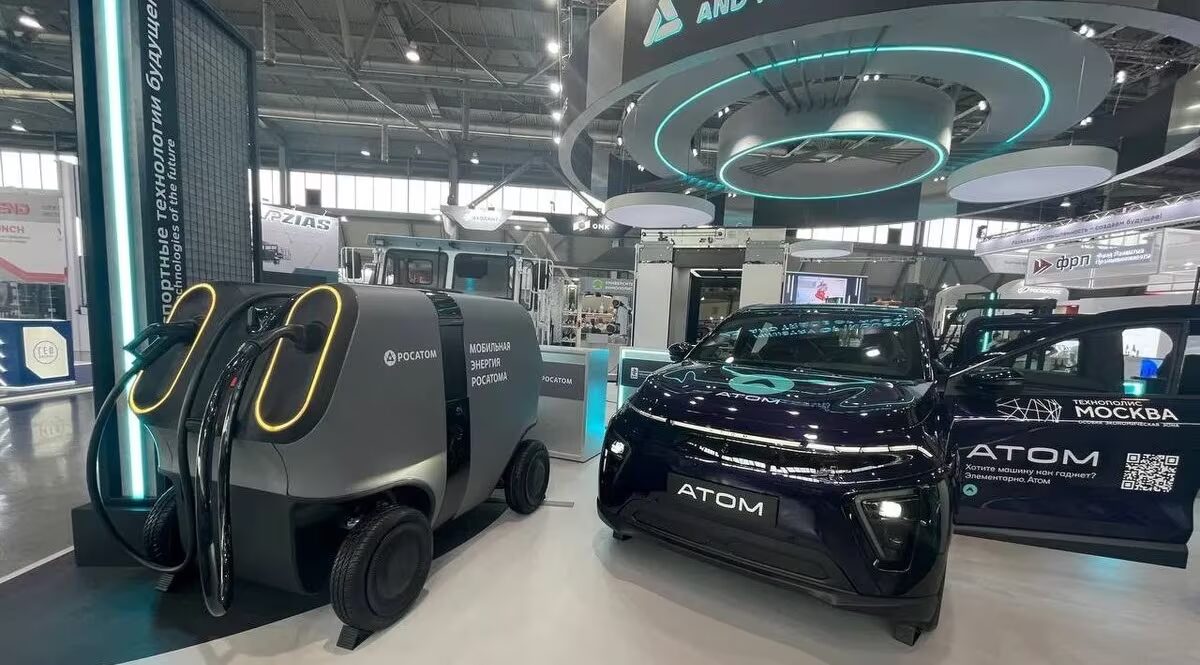
Rosatom showcased a fully autonomous mobile charging station for electric vehicles at Innoprom 2026, designed to drive itself directly to a parked EV, top it off, and return to base-all without any driver intervention. This self-driving charger offers a fresh solution for locations where installing fixed charging infrastructure is slow, costly, or simply impractical.
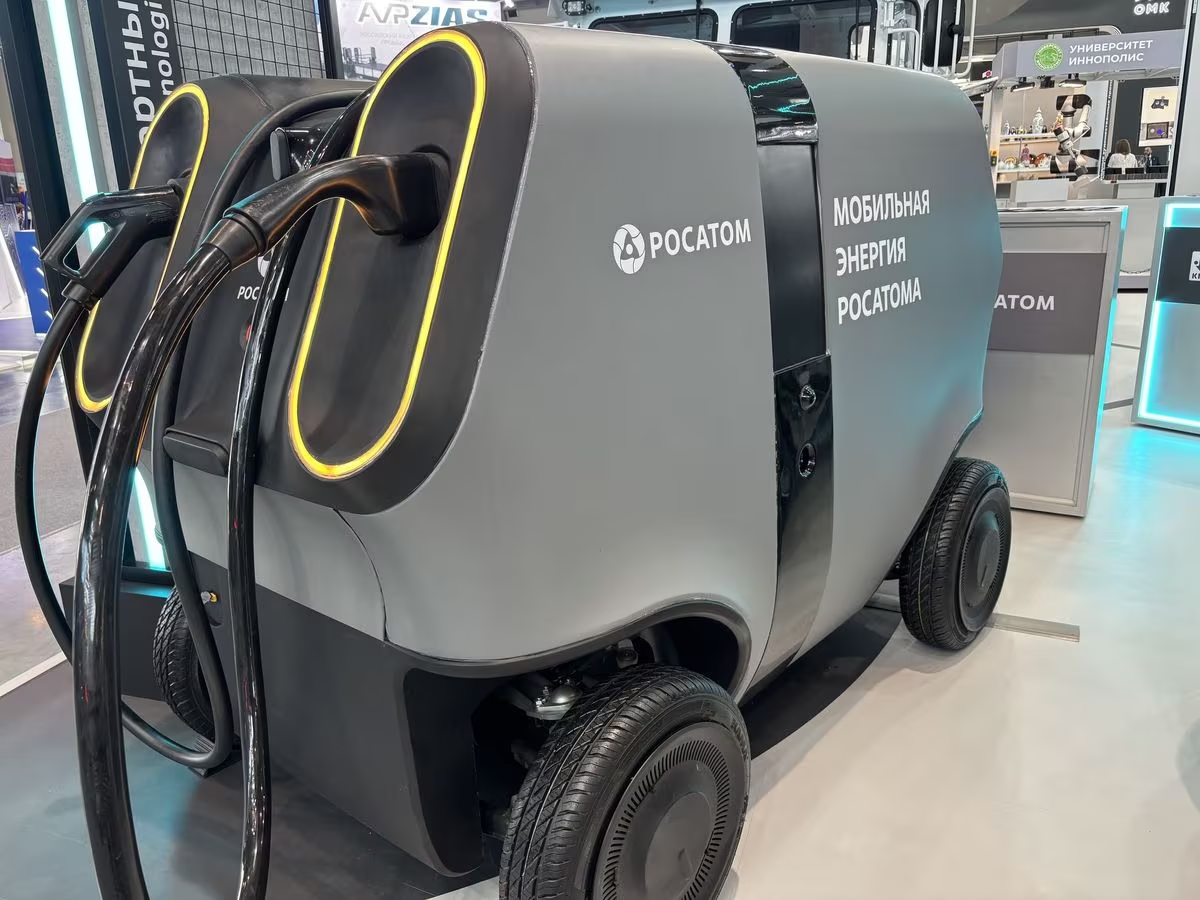
The mobile station features an onboard energy storage unit with a capacity of up to 105 kWh, delivering up to 60 kW of continuous DC power. According to Rosatom’s estimates, it can recharge a typical EV battery in around 30 minutes. After charging, the unit autonomously returns to a recharging module to replenish its own battery supply.
This design targets multiple environments: office parks, residential complexes, retail centers, and roadside parking lots. Its mobile nature eliminates the need to immediately lay powerful fixed infrastructure lines to every parking spot, which is especially relevant for Russia, where EV adoption is climbing but charging networks remain patchy. As of early 2026, Russia had over 60,000 registered electric vehicles, according to automotive statistics.
Technical specifications of Rosatom’s mobile EV charger
- Built-in battery capacity: up to 105 kWh
- Peak charging power: up to 60 kW DC
- Charging time for an average EV battery: approximately 30 minutes
- Autonomous navigation throughout the parking area without relying solely on GPS
- Navigation aided by digital maps, camera, radar, and lidar sensors
- Remote operator takeover capability for complex scenarios
The autonomous system maneuvers around obstacles, approaches the vehicle for charging, then returns to its base. Notably, Rosatom’s charger uses a combination of digital site maps and onboard sensors instead of solely relying on GPS, which often proves unreliable or imprecise in indoor parking or enclosed areas.
Human intervention remains possible: if the AI encounters a scenario it can’t safely navigate, control switches to a remote operator via a secure channel. This approach mirrors common practices in autonomous systems, where routine operations are automated but human oversight handles edge cases.
Similar concepts have surfaced from other companies. Volkswagen demonstrated a robotized charger years ago that moved battery modules to EVs within parking garages, while UK startup ZipCharge promoted compact mobile battery units to recharge vehicles without fixed stations. Yet, such solutions rarely reach widespread use due to high battery costs, strict safety requirements, and the complexity of integrating them into dynamic, real-world parking environments.
For Rosatom, this project extends its work in electric vehicle infrastructure and energy storage systems. Should pilot deployments on private properties prove economically viable, mobile chargers could become a practical stopgap between areas with no charging availability and building extensive fixed charging hubs. The true test will be how well these mobile stations perform once they hit the market and face the unpredictability of daily use.