

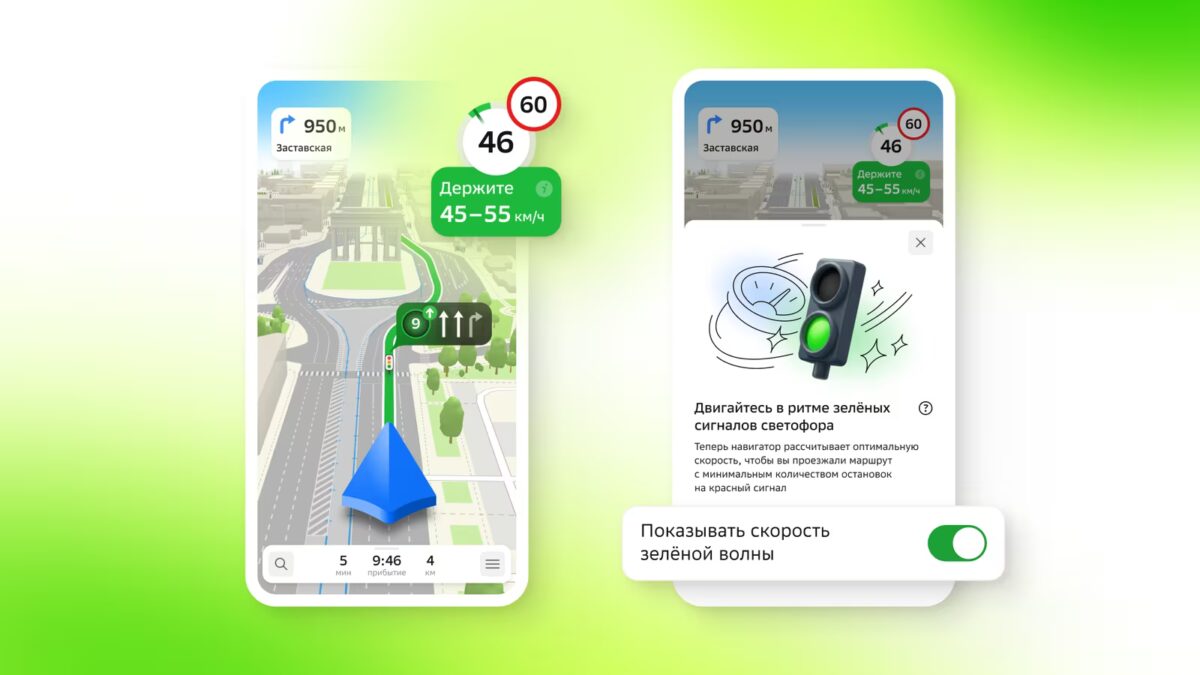
2GIS has introduced a green wave mode for St. Petersburg that advises drivers on optimal speeds to catch consecutive green lights without breaking traffic laws. This feature works where smart traffic signals are already installed and follows the app’s earlier update showing real-time traffic light statuses.
The system calculates traffic light cycles, distances between intersections, and your current speed, usually recommending a pace between 45 and 60 km/h. In some sections, the suggested speed may be lower. The goal is simple: fewer stops, less harsh acceleration and braking, and a smoother traffic flow.
The longest green wave stretches are currently on Moskovsky, Leninsky, and Kamennoostrovsky avenues. 2GIS receives its data from St. Petersburg’s City Road Traffic Management Directorate. The feature is available now in the latest iOS and Android versions of the app, with plans to integrate it into Apple CarPlay and Android Auto soon.
How 2GIS green wave mode works
By using synchronized traffic light data and real-time vehicle speed, the green wave mode calculates optimal driving speeds to minimize stops at red lights. This approach enhances urban driving by promoting smoother acceleration and braking, reducing fuel consumption and vehicle wear.
Comparison with existing green wave technologies
Similar technology has mostly been limited to experimental pilots. Audi’s Green Light Optimal Speed Advisory in the US, launched years ago, also suggested speeds to help drivers catch green lights without stopping. However, it is rare to see these capabilities integrated into consumer navigation apps, which usually focus on traffic jams, accidents, and speed cameras rather than syncing routes to city traffic signals.
Benefits of green wave driving for eco-driving and traffic flow
The practical benefits are clear. Eco-driving studies show smooth driving can cut fuel consumption by 5-15% in urban conditions, while also reducing noise and brake wear. If 2GIS expands this green wave feature beyond a handful of major roads, St. Petersburg could become a strong test case to prove if syncing navigation to traffic lights truly improves real-world driving experiences rather than just offering better route maps.