

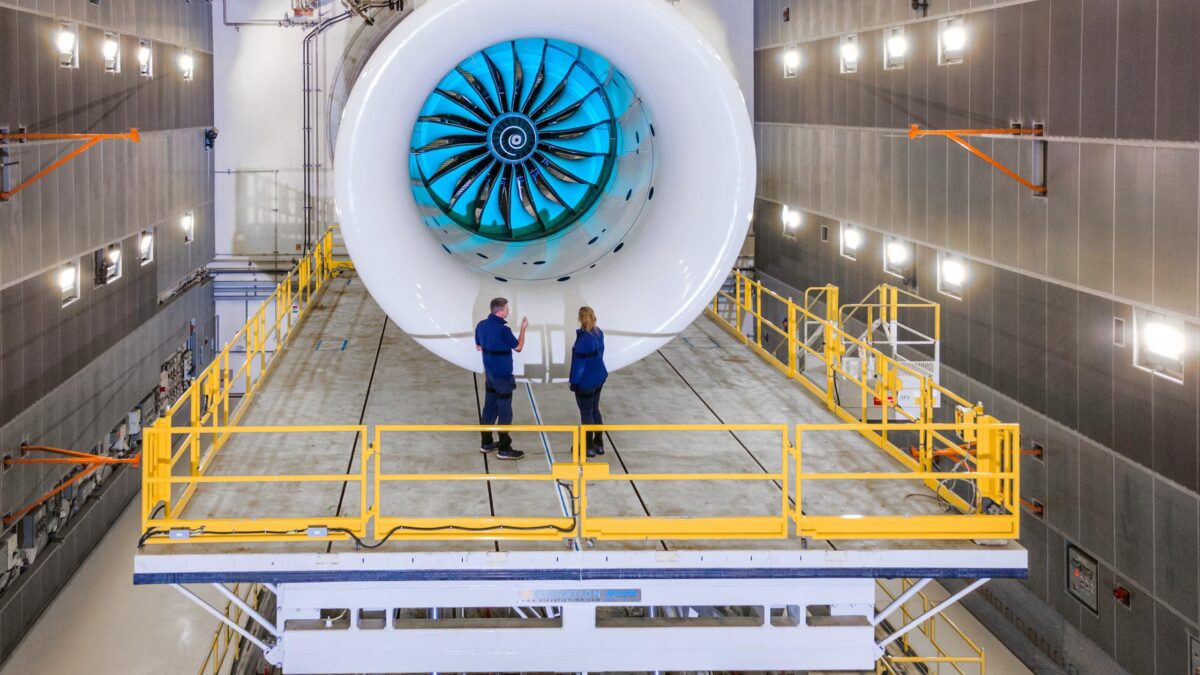
Rolls-Royce is gearing up to restart testing of its UltraFan 80 aircraft engine prototype by the end of 2026 at its Derby test facility. The goal is to assess whether the redesigned engine delivers improved reliability and fuel efficiency following initial trials earlier this year-but there’s one catch: no aircraft has yet been announced to use this engine.
The first UltraFan demonstrator ran about 70 hours during early tests in 2023. Since then, Rolls-Royce has overhauled several components, including a new high-pressure compressor and other refinements aimed at extending engine lifespan and boosting fuel economy. This isn’t just a minor refresh; the company clearly wants to move UltraFan from an impressive lab project to a viable foundation for a real production engine program.
The next crucial step is flight testing on a carrier aircraft to reach Technology Readiness Level (TRL) 6-that is, demonstrating the engine works in conditions close to actual service. Rolls-Royce hasn’t disclosed which aircraft will serve as the testbed. This silence is telling: without airborne testing, even stellar bench results fall short of convincing the market.
Alongside the UltraFan 80 for widebodies, Rolls-Royce is also developing a smaller UltraFan 30 variant targeting single-aisle jets. That one is slated for a first run in 2028. The single-aisle engine space is crowded and fiercely competitive, dominated by CFM International’s LEAP series and Pratt & Whitney’s geared turbofan PW1000G engines.
Rolls-Royce UltraFan technology overview
UltraFan is Rolls-Royce’s bid to reassert itself in the commercial aviation engine arena-not just on widebody planes, where its Trent family is well established, but also for next-generation platforms. The engine is designed as a modular system featuring a geared turbofan architecture, composite fan blades, and a significantly larger fan diameter. The company claims this technology could cut fuel burn by up to 25% compared to first-generation Trent engines over the family’s long-term evolution.
That ambition comes with challenges. Airbus and Boeing have been slow to introduce all-new widebody airframes, favoring incremental updates to existing models. UltraFan 80’s sophistication and size make it hard to fit on today’s jets designed for different engine types, so Rolls-Royce admits it’s unlikely to see service on current aircraft.
In contrast, the UltraFan 30 targets the high-volume single-aisle sector-the biggest segment of commercial aviation. Boeing and Airbus expect airlines to need more than 30,000 new narrowbodies over the next two decades. If next-generation platforms take shape as planned in the 2030s, UltraFan 30 could help Rolls-Royce reclaim a market it exited decades ago.
Meanwhile, competitors are advancing their own engine technologies. CFM International is developing its RISE program aiming for open-rotor engines with double-digit fuel savings by the mid-2030s, while Pratt & Whitney continues refining its geared turbofan lineup and rolling out the GTF Advantage upgrade for existing planes. Rolls-Royce’s strategy diverges: instead of rapidly updating existing engines, it’s betting on a powerplant for aircraft models still on the horizon.
Whether UltraFan will evolve from a promising demonstrator into a full commercial engine remains uncertain until the end of the decade. The key question is when Airbus or Boeing will launch a new generation of mid-sized airliners. If those timelines keep slipping, even successful tests in Derby and flight labs may leave UltraFan as a technically impressive project without a production aircraft to call home.
Rolls-Royce’s UltraFan program underscores the tricky balance between engineering innovation and the slow churn of aircraft development cycles. For engine makers, timing and partnerships are as critical as breakthroughs. Watching how UltraFan fits into future airframes will be essential for anyone tracking the evolution of jet propulsion.