

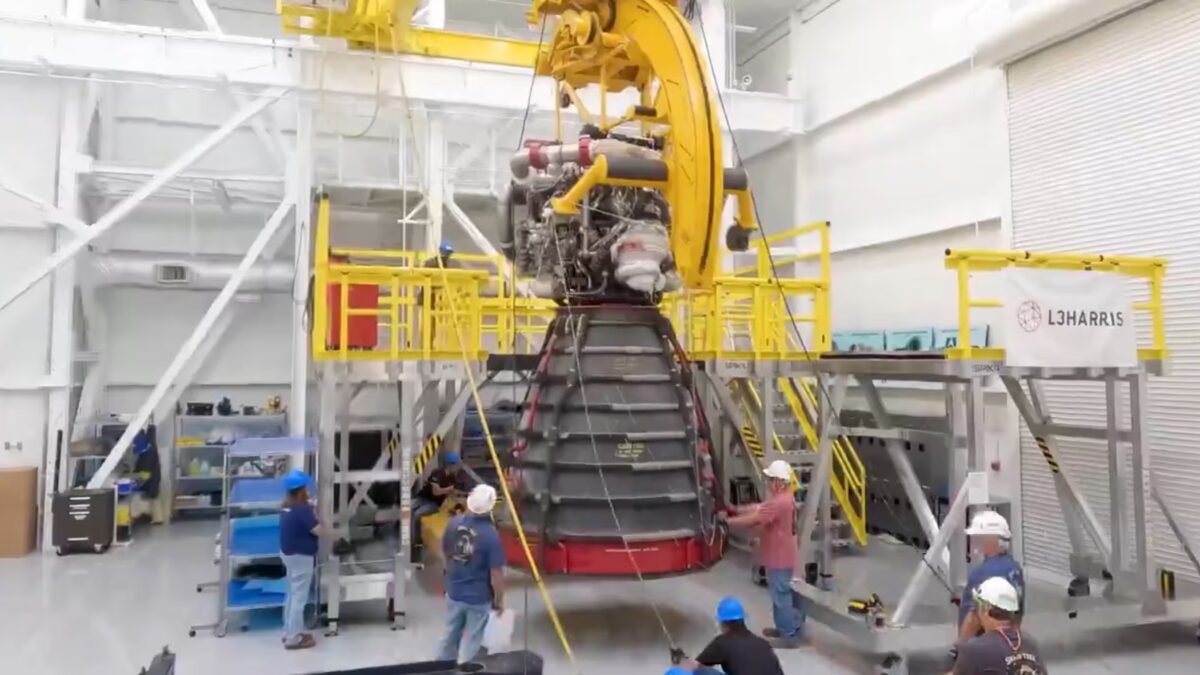
NASA has delivered two of the four RS-25 engines destined for the Space Launch System’s (SLS) core stage, gearing up for the Artemis III mission. This launch aims to mark the return of American astronauts to the Moon with a crewed landing, the first since Apollo 17 in 1972. The agency even shared a video showing one of the engines being transported across the Kennedy Space Center grounds.
The RS-25 engine is a veteran of American spaceflight, originally designed for the Space Shuttle program and later upgraded for the SLS and Artemis missions. Running on liquid hydrogen and liquid oxygen, these engines offer an extremely high specific impulse compared to typical chemical rocket engines, though their complexity makes them expensive and challenging to operate.
Each RS-25 engine produces roughly 232 tons of thrust. Equipped with four engines on the SLS core stage, that totals nearly 930 tons of thrust, and when combined with two solid rocket boosters, the total push-off thrust tops 4,000 tons. The RS-25s burn for about eight minutes post-launch, accelerating the core stage until it separates. The same engine configuration powered Artemis I’s maiden SLS flight back in 2022.
Artemis III is currently slated for 2027. The mission plan includes a roughly two-week journey through low Earth orbit with three heavy-lift launches and two dockings at about 463 kilometers altitude. NASA will test how the Orion crew capsule operates alongside commercially developed lunar landers. If timing holds, this will be the first U.S. crewed Moon landing in over five decades.
However, the Artemis program faces ongoing challenges with cost and schedule. NASA has pushed Artemis II and III further out following repeated delays, while Congressional auditors have long criticized the SLS’s soaring costs-estimating each launch could cost several billion dollars. Against this backdrop, even the delivery of just two engines signals the mission’s incremental progress rather than a smooth march to the Moon.
Compared to commercial heavy-lift rockets like SpaceX’s Starship, which aim for rapid reusability and significantly lower costs, the SLS’s expendable RS-25 engines reflect an older spaceflight philosophy focused on proven hardware and incremental upgrades. How NASA balances budget pressures with the desire to maintain a strong crewed lunar program will define Artemis’s trajectory over the next decade.
Looking ahead, the key question remains whether NASA can keep Artemis III on track for a 2027 crewed lunar landing. The gradual rollout of the SLS core stage components, like these RS-25 engines, will be a critical barometer-not just for Artemis, but for America’s broader ambitions to sustain a permanent presence on and around the Moon.