

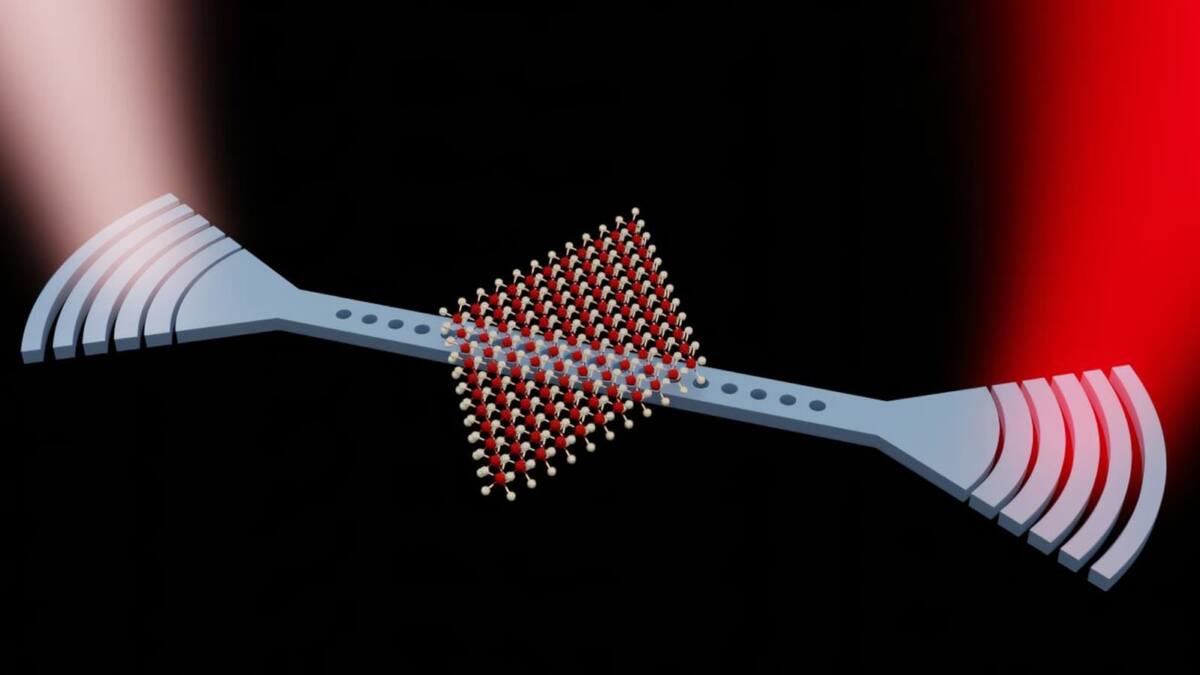
A team at the University of Pennsylvania has shown a way to make light do computing work with almost no energy loss, using hybrid light-matter particles called exciton-polaritons. The pitch is obvious: if AI keeps guzzling more power and pumping out more heat, the next big efficiency win may not come from a faster GPU, but from ditching electronics for optics where possible.
The researchers built an optical switch from an ultra-thin semiconductor inside a nano-optical cavity, where light couples with excitons and forms exciton-polaritons. That matters because plain photons are great at moving information quickly, but famously bad at interacting with each other, which makes logic operations awkward.
A photonic switch that runs on 4 femtojoules
The headline number is 4 femtojoules per operation. That’s so tiny it would not be enough for even a brief flash from a regular LED, and it puts the demo among the most efficient photonic systems reported so far. The obvious winner here is the data center operator watching the power bill; the loser is the old assumption that every useful computation has to become heat first.
- Platform: exciton-polaritons
- Core function: optical switching without converting the signal to electricity
- Energy per operation: about 4 femtojoules
Photonic computing has been dangled as an answer to AI’s energy problem for years, but the catch has always been the same: getting light to behave like logic, not just transport. This experiment chips away at that problem by creating strong enough interactions inside the device itself, which is the sort of trick that gets engineers interested and finance teams nervous.
Why AI hardware is looking beyond GPUs
The pressure comes from the scale of modern machine learning. Bigger models need more computation, more servers, and more cooling, and cooling is no longer a footnote in the cost structure. That is why optical and neuromorphic approaches keep resurfacing: they are not magic, but they do offer a way to move bits without turning half the machine room into a space heater.
For now, though, this is a lab result, not a product. The next hurdle is proving the system can hold up inside larger computing architectures, where stability, fabrication, and integration tend to ruin elegant physics very quickly.
What has to happen before photonic AI chips arrive
If the approach scales, fully optical neural networks could become a real alternative for some AI workloads, especially where energy efficiency matters more than brute-force flexibility. The better bet is not a sudden replacement of silicon, but a hybrid future in which photonic components handle the hottest, most power-hungry parts of the job.
The open question is whether this kind of switch can be manufactured reliably enough to move beyond a clean demonstration. Physics has done its part; now the semiconductor industry gets the awkward assignment.