

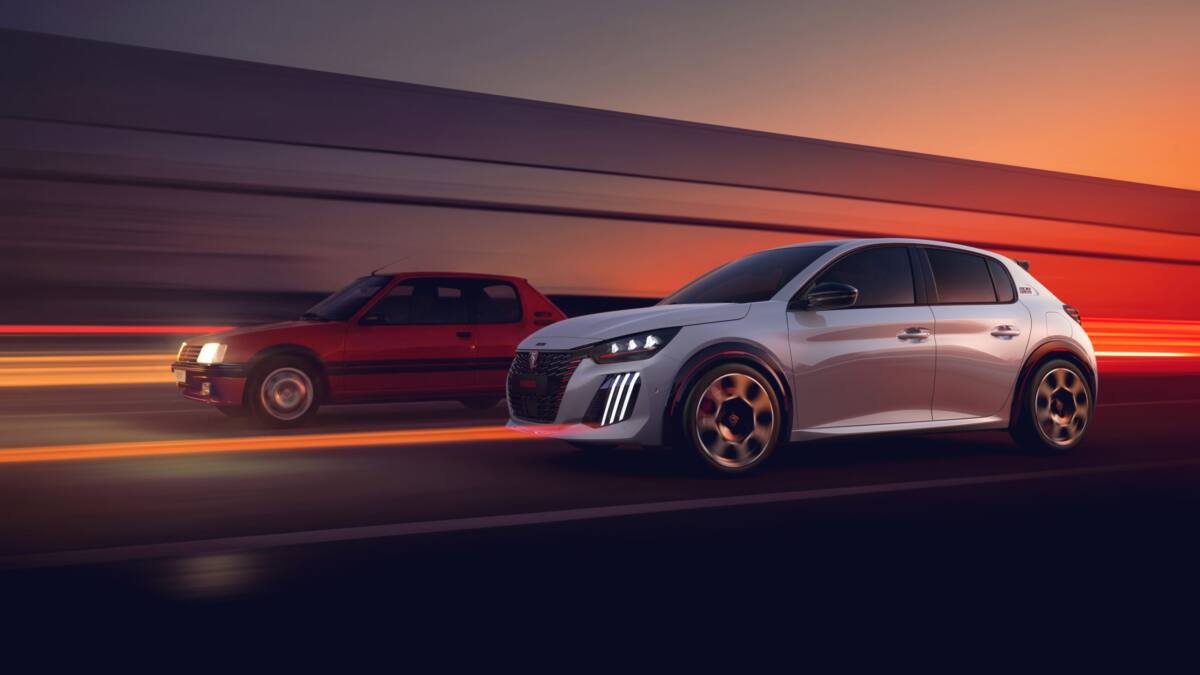
Peugeot has turned the E-208 GTi from tease to reality, and the headline is simple: the Peugeot E-208 GTi is now a fully electric hot hatch. Unveiled at the 24 Hours of Le Mans and already open for orders, it is Peugeot’s first fully electric model to carry the GTi name, which should please the quiet majority and annoy a few purists in equal measure.
Under the skin, this is not just a badge swap with some red trim. Peugeot Sport developed the car around an M4+ electric motor rated at 281 hp and 345 Nm of torque, while control software borrowed from the company’s Hypercar program helps deliver a power-to-weight ratio of 5.5 kg/hp. That puts it squarely in the fast hot hatch conversation, where instant torque is the whole point and nostalgia is increasingly optional.
Peugeot E-208 GTi performance figures
- Power: 281 hp
- Torque: 345 Nm
- 0 to 100 kph: 5.5 seconds
- 1,000m standing start: 25.8 seconds
- Top speed: 180 kph
Battery, charging and daily use
The E-208 GTi uses a 54 kWh battery with thermal management designed to keep power delivery steady across different driving conditions. Peugeot says a 100 kW DC rapid charger can take the pack from 20% to 80% in less than 30 minutes, while a 7.4 kW Wallbox completes a full charge in 4 hours and 40 minutes. That makes the car more usable than the old-school hot hatch playbook would suggest, especially for drivers who want speed without living at the charging station.
Peugeot is also leaning on warranty and charging perks to make the package easier to swallow. Buyers get Care coverage for up to 8 years or 160,000 km, a Free2Move Charge Pass for access to charging networks across Europe, and V2L capability for powering external devices. In other words: performance car, family-car paperwork.
Chassis changes and GTi styling
The hardware changes go well beyond software and motor output. Compared with the standard E-208, the GTi sits 25 mm lower, its track is widened by 56 mm at the front and 28 mm at the rear, and it gains a 31 mm rear anti-roll bar, a mechanical limited-slip differential, exclusive dampers with hydraulic bump stops, and 355 mm front discs with fixed four-piston calipers. That is a properly serious recipe, not just a cosmetic one with a louder press release.
Visually, Peugeot has gone heavy on the detail work: flared wheel arches, a glossy black rear diffuser, and 18-inch perforated wheels set the tone. The ”GTi Red” theme runs through the grille, badges, brake calipers, digital displays, seatbelts, and even the carpets, because subtlety clearly did not make the options list.
The big question now is whether this formula can bring younger buyers into the GTi fold without alienating the badge’s older fan base. Given how rival brands have struggled to translate legacy performance names into electric form, Peugeot may have landed on the safer answer: keep the numbers sharp, keep the chassis credible, and let the badge argue with itself later.