

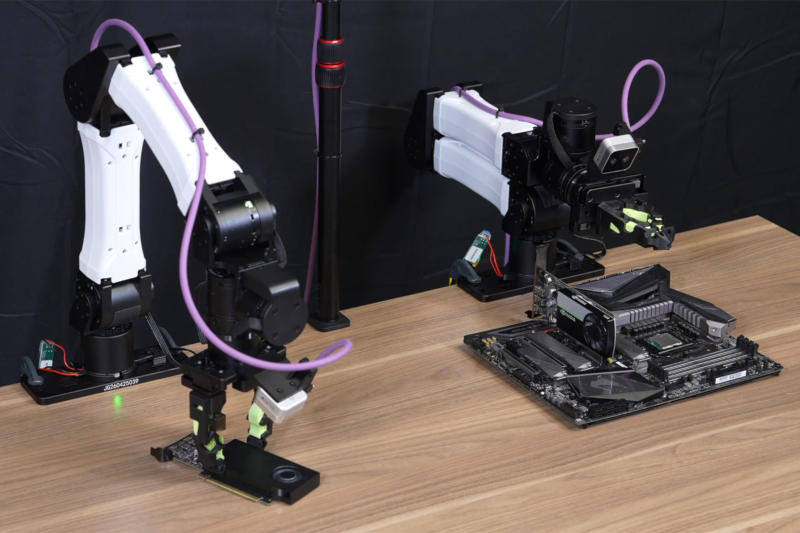
Nvidia has shown off an AI robots demo that can learn real-world tasks on the fly, including one party trick that will hit a nerve with PC builders: a robotic arm inserting a graphics card into a motherboard. The demo is part of ENPIRE, a project built around multiple AI agents, robot arms, and a token budget that lets the machines practice, fail, and try again until they get the job done.
The funny part is the hardware choice. The robots were trusted with modest, compact graphics cards, not monster-class GPUs such as the RTX 5090. In other words, Nvidia let them handle the screwdriver-adjacent work, but not the expensive crown jewels. Sensible? Absolutely. Dramatic? Also yes.
What the ENPIRE robots can do
In the demo, the robots install a graphics card into a motherboard, sort metal pins in a container, and fit and trim plastic cable ties. The system is designed to train high-precision skills in the physical world, with agents setting goals and then learning how to complete them quickly without making mistakes.
According to the project description, the robot fleet starts probing visual cues, resetting scenes, trying new skills, tweaking control functions, reading articles on the internet, and repeating attempts directly on the equipment. That sounds less like a factory line and more like a very determined study group with mechanical arms.
Eight AI agents, three coding stacks
The researchers ran eight OpenAI Codex agents with GPT-5.5, alongside Claude Code with Opus 4.7 and Kimi Code with Kimi K2.6. That mix matters because robotics is increasingly becoming a software race as much as a hardware one: the company that can make agents coordinate, recover from errors, and generalize faster gets the edge, even before the robots get better hands.
- Task examples: insert a graphics card, sort metal pins, fit cable ties
- AI tools used: OpenAI Codex, Claude Code, Kimi Code
- Reported setup: eight robots exploring in parallel
- Hardware choice: compact graphics cards, not RTX 5090-class boards
Eight robots solved the task faster
The team also tested different swarm sizes and found that eight robots working in parallel solved the task much faster than a smaller group. That fits the broader robotics playbook: parallel exploration reduces trial-and-error bottlenecks, which is especially useful when the whole point is to teach machines through repetition instead of hand-coded routines.
For Nvidia, the message is clear. The company is pushing AI beyond chat and into motion, and the next step is not whether a robot can do one careful PCIe insertion. It is whether it can do that reliably, at scale, after a dozen awkward failures and a few panicked resets.