

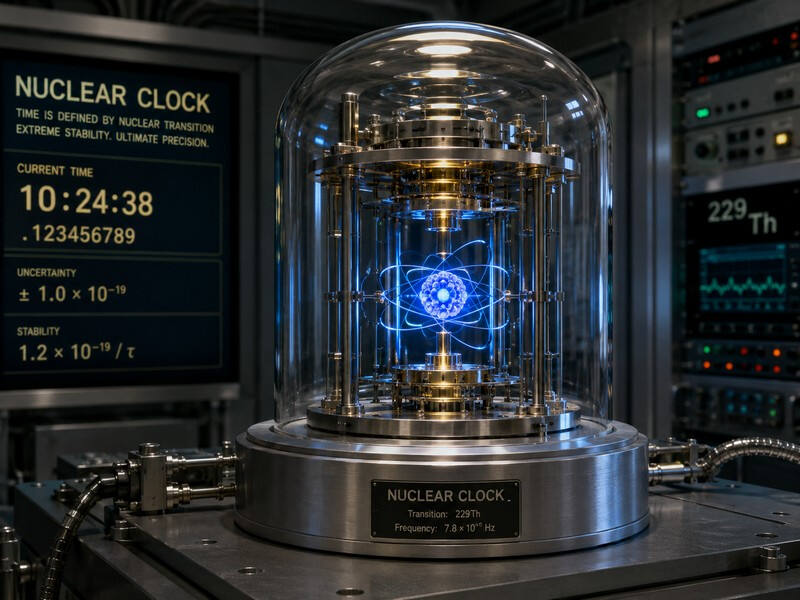
Physicists have finally built a working nuclear clock, a device that keeps time using transitions inside an atomic nucleus rather than the electron jumps that power today’s atomic clocks. The first prototype uses thorium-229, a strange little isotope that has been teasing researchers for decades because its nuclear transition is unusually easy to excite with a laser. If the technology matures, it could do more than shave errors off timekeeping: it may also become a sharp new probe for dark matter and other tiny changes in the laws of physics.
That is a pretty big deal because atomic clocks are already absurdly good. The best optical atomic clocks lose less than a second over hundreds of millions of years, so nuclear clocks are not entering a relaxed competition. They are trying to beat a benchmark that is already close to ridiculous. Still, the nuclear route has one obvious advantage: the nucleus is much less exposed to stray electromagnetic noise than an electron cloud, which should make it easier to build clocks that stay stable under hostile conditions.
Why thorium-229 matters
The key breakthrough is thorium-229’s extremely low-energy nuclear transition, measured at about 8.4 eV. That makes it reachable with an ultraviolet laser; most nuclear transitions are far too energetic and would need gamma rays instead, which is a very different kind of headache. In the prototype, the laser is tuned to that transition so the nuclei absorb and re-emit photons in a stable rhythm that acts like the clock’s tick.
Researchers embedded the thorium-229 nuclei in a calcium fluoride crystal, which is transparent to the needed ultraviolet light and keeps the atoms locked in place. The signal comes from the collective behavior of many nuclei, not a lone atom trying to behave itself, and that helps with measurement stability. It is an elegant trick, and also a reminder that precision physics often looks like wrestling a very expensive sparkle in a box.
From a 1970s idea to a live experiment
The concept has been around since the 1970s, but progress was throttled for years by one annoying problem: scientists did not know the thorium transition well enough to aim a laser at it with confidence. That changed only after a string of recent experiments narrowed down the numbers, including a 2024 effort from JILA, the joint institute involving the University of Colorado Boulder and the U.S. National Institute of Standards and Technology. In other words, this was less a sudden leap than a long overdue unlock.
The current prototype is not yet more accurate than the best optical atomic clocks, so nobody is crowning a new king of time just yet. But working hardware matters more than a paper promise, because it gives engineers a platform to improve the lasers, refine the crystal quality, and squeeze out better performance.
What nuclear clocks could detect
The most interesting part may be what these clocks can sense, not just how well they count seconds. Because the nucleus responds to strong and weak nuclear interactions, nuclear clocks are suited to spotting shifts in fundamental constants that atomic clocks might miss. That opens the door to tests of whether those constants drift over cosmological timescales, which is exactly the sort of question that gets cosmologists and particle physicists to stop pretending they only care about calendars.
- Core isotope: thorium-229
- Transition energy: about 8.4 eV
- Excitation method: ultraviolet laser
- Host material: calcium fluoride crystal
There is also a more speculative prize: searches for ultra-light dark matter. Some theories say such particles could cause tiny periodic changes in fundamental constants as Earth moves through them, and a nuclear clock compared with an optical atomic clock might be sensitive enough to catch the wobble. If that happens, the humble act of keeping time could end up helping to map the dark side of the universe.
The next question is whether the prototype can be pushed from ”working” to ”usefully better.” If the answer is yes, nuclear clocks could become a niche instrument for elite labs first, then a standard reference for the most exacting measurements in physics.