

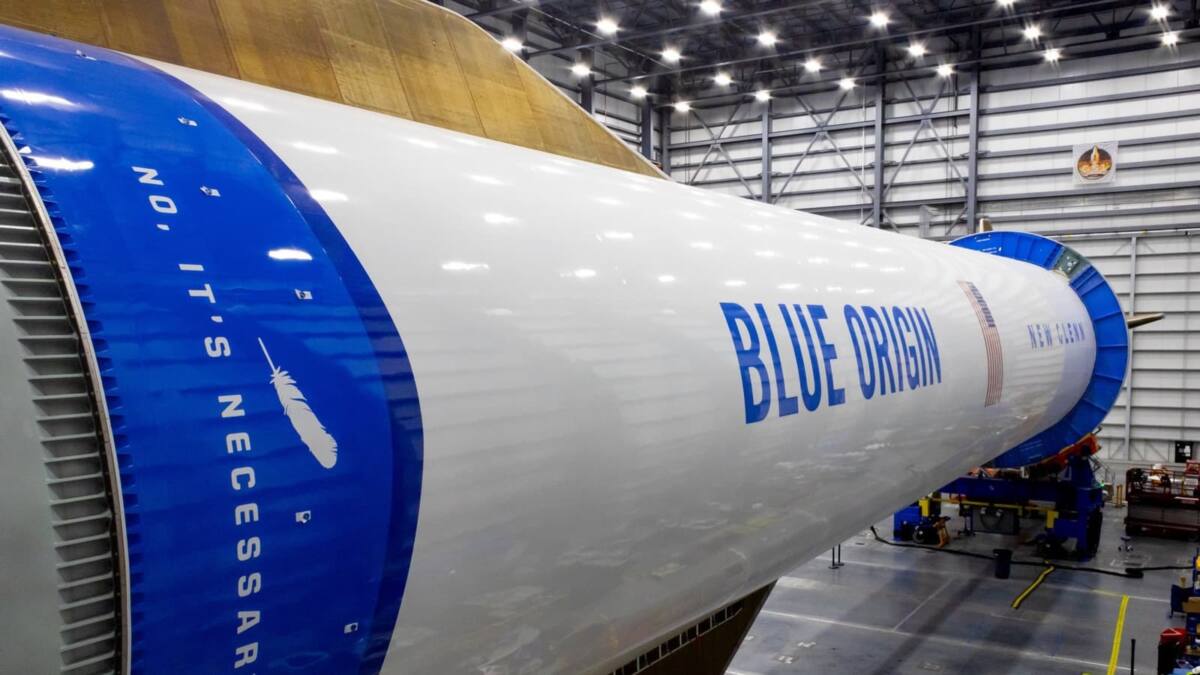
Blue Origin’s New Glenn is lined up to carry 48 Amazon Leo satellites on its first mission for Amazon’s broadband network, a launch expected in early June 2026. For Amazon Leo, that’s a big milestone: the company is moving from paper plans and early deployment into the kind of heavy-lift cadence that turns a satellite constellation into an actual service.
The flight, called LN-01, is the first of 24 planned launches on New Glenn and will be the largest payload yet for Amazon Leo. That matters because the company is racing to build a low-Earth-orbit network of more than 3,200 satellites, a scale that only a small club of launch providers can support without drama, delays, or a spreadsheet full of pain.
What Amazon Leo is building
Amazon Leo, formerly Project Kuiper, is designed to deliver high-speed broadband to regions that terrestrial networks still struggle to reach. The satellites will sit in three shells at 590 km, 610 km, and 630 km, a setup meant to balance coverage, capacity, and latency. It’s a familiar playbook in the satellite internet race, but Amazon is arriving late enough that execution now matters more than ambition.
At first, each New Glenn launch is expected to carry 48 satellites, with payloads increasing later as the rocket is worked into regular service. That staged approach is sensible. SpaceX has already shown how valuable launch reusability and bulk deployment can be here, and Amazon is clearly trying to build reliability by spreading its bets across multiple launch systems instead of leaning on one rocket and hoping for the best.
New Glenn lift capacity and reuse plan
New Glenn is a two-stage launcher more than 98 meters tall, powered on its first stage by seven BE-4 engines. Blue Origin says it can place up to 45 tons into low Earth orbit and recover the first stage for reuse, which is the whole point: more payload than a medium launcher, less waste than a throwaway one. If that recovery routine holds up, Amazon gets a stronger domestic option for launching large batches without relying entirely on outside providers.
- Launch vehicle: New Glenn
- Payload for LN-01: 48 Amazon Leo satellites
- Planned launch window: early June 2026
- Constellation size: more than 3,200 satellites
- Orbital layers: 590 km, 610 km, and 630 km
- New Glenn capacity: up to 45 tons to low Earth orbit
Why this launch matters for Amazon Leo
The quiet story here is diversification. Amazon needs launch capacity at industrial scale, and New Glenn gives it another route beside the other rockets already in the mix. That kind of redundancy is boring until a schedule slips, a booster underperforms, or the business model runs into the hard limit of too few flights and too many satellites waiting on the ground.
The next question is whether Blue Origin can turn New Glenn into a dependable production launcher, not just a headline machine. If LN-01 goes smoothly, Amazon gets a cleaner path to mass deployment; if not, the constellation timeline gets dragged back into the kind of orbit mechanics no one wants to explain to investors.