

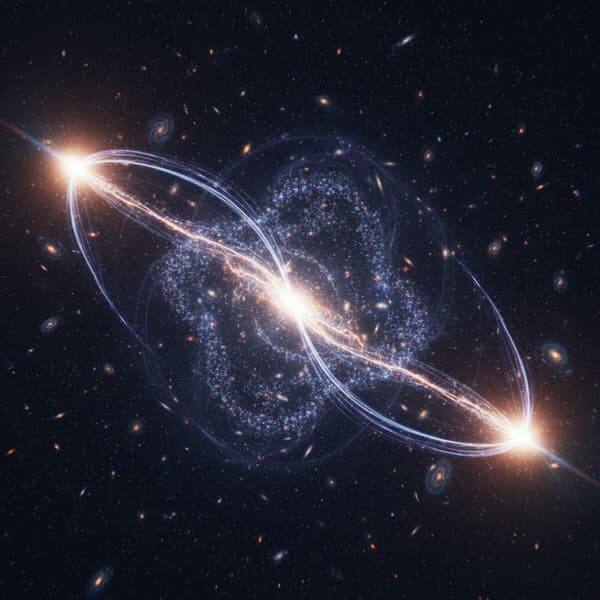
Neutrinos have been used for one of the cleanest gravity tests yet: an international team says it has checked Einstein’s weak equivalence principle with record precision by timing high-energy neutrinos from two blazars and folding in the gravity of the Laniakea supercluster. The result tightens the noose on any theory that would make different particles fall differently, and it does so on a truly cosmic baseline rather than in a lab-sized setup.
The study leans on open IceCube data from the blazars TXS 0506+056 and PKS 0735+178. The team used the Shapiro effect, the relativistic time delay caused by gravity, and for the first time included Laniakea’s potential, which acts like a gigantic natural amplifier for tiny timing differences. That’s the sort of trick physicists love: same old theory, bigger ruler.
How the blazars were used as timing beacons
Active galactic nuclei are handy for this kind of test because they can emit neutrinos and photons almost at the same time. In this case, the measured delays were 175, 15, and 7 days for TXS 0506+056, and 4 days for PKS 0735+178. Those numbers sound messy, but in gravity-testing terms they are exactly the kind of imperfect real-world signal scientists can still squeeze for fundamental physics.
By accounting for the gravitational influence of Laniakea, the researchers say they improved the sensitivity by 1 to 3 orders of magnitude compared with earlier work. Their quoted precision is around 10-7, a leap that pushes far beyond limits derived from SN1987A. That old benchmark has been hanging around for decades, so this is a neat reminder that astronomy keeps handing physicists sharper tools than the last generation had.
What the Laniakea supercluster changes
The key idea is simple: if gravity stretches travel time, then a larger gravitational environment gives you a stronger test. Treating Laniakea as a kind of ”gravity lens of time” let the team sharpen limits even for an object already studied before, PKS B1424-418, where the bound reportedly improved from 10-4 to 10-6. That’s the kind of upgrade that makes yesterday’s constraint look embarrassingly soft.
There is still a catch, and the authors are right to say so. Internal delays inside the sources themselves can blur the signal, so the result is not a magic verdict carved into stone. But as a test of the weak equivalence principle for relativistic particles, it is about as strong as this method has gotten.
What comes after this neutrino gravity test
The next step is obvious enough: more events, better statistics, fewer excuses for uncertainty. Detectors such as KM3NeT and CTAO should help build that sample, and if they do, physicists may be able to probe subtler effects that sit beyond the Standard Model. For now, Einstein’s old rule survives another very modern stress test.