

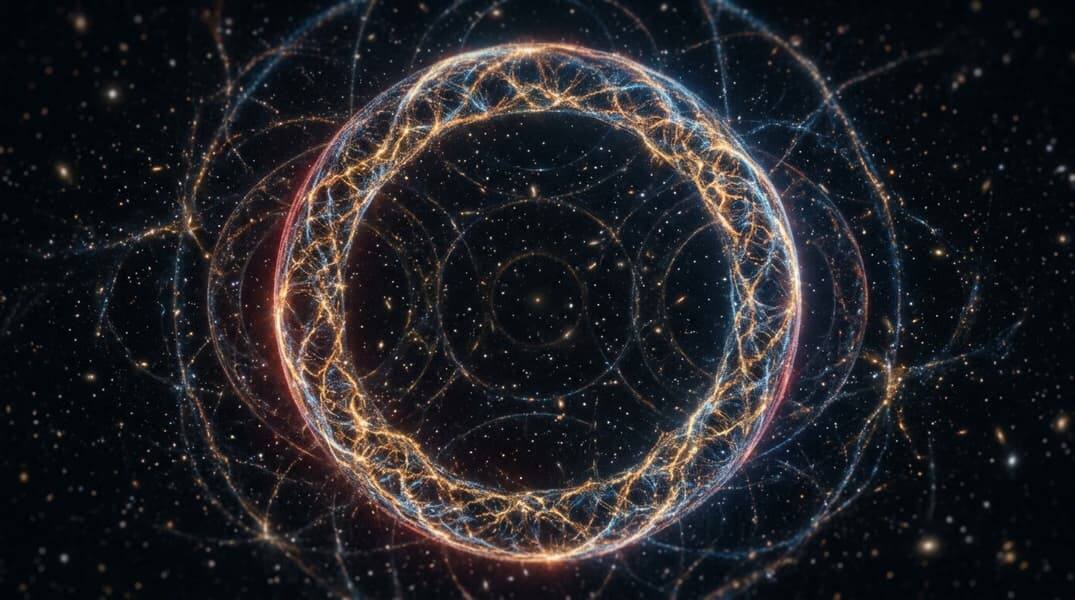
A team from the University of Central Lancashire says it has found another monster structure in the deep sky: a Giant Ring about 1 Gpc across, wrapped around a larger ring and sitting in the same patch of sky as other record-sized features. If that sounds inconvenient for the tidy picture of a smooth, evenly mixed universe, that is because it is.
The Giant Ring raises questions for the standard cosmological model, ΛCDM, which assumes that on very large scales the universe should look homogeneous and isotropic. The structure is far larger than the commonly cited homogeneity scale of about 370 Mpc, which is why this discovery is being read as more than just another pretty pattern in the data.
How the Giant Ring was identified
The team used data from SDSS DR16Q and applied strict filtering, including signal-to-noise checks and local continuum characteristics, before using a projection-plane method to reduce distortion. That kind of cleanup matters: without it, a lot of ”structures” in astronomy turn out to be wishful thinking with better graphics.
According to the researchers, the Northern Arc appears as a thin filament, while the southern region includes parts of the previously reported Giant Arc. On the western edge, the structure branches, hinting that more than one ring or torus may be overlapping in the same region.
Illustration: Nano Banana
Why the Giant Ring is hard to dismiss
What makes the claim especially awkward is the nested geometry. The Giant Ring appears to surround a Big Ring, forming an almost concentric arrangement that the authors say is extremely unlikely to happen by chance.
They report statistical significance above 4σ, with clustering analysis at 3.53σ, and say tests using elliptical shells and two-dimensional energy-spectrum analysis support the structure being real. In practice, that pushes the debate away from ”is this just noise?” and toward ”what sort of universe keeps drawing circles this large?”
What could explain a structure this large
The authors argue that objects like the Giant Ring, the Giant Arc, and the Big Ring may require a rethink of ΛCDM. They also point to conformal cyclic cosmology, associated with Roger Penrose, as one possible framework in which such features could be interpreted as gravitational traces from a previous aeon.
That is still a speculative reading, but it is not a random one. Cosmology has a long history of discovering that the universe tolerates a little less neatness than theorists would like, and the uncomfortable part is that this team says it has now found several of these outliers in the same area of sky.
What happens if more giant structures show up
If future surveys keep turning up similarly vast rings, arcs, and filaments, the pressure will build on the cosmological principle itself. For now, the bigger question is not whether this single structure is impressive – it plainly is – but whether it is a one-off oddity or the first obvious sign that the large-scale universe is more lumpy, layered, and stubbornly geometric than the textbooks promised.