

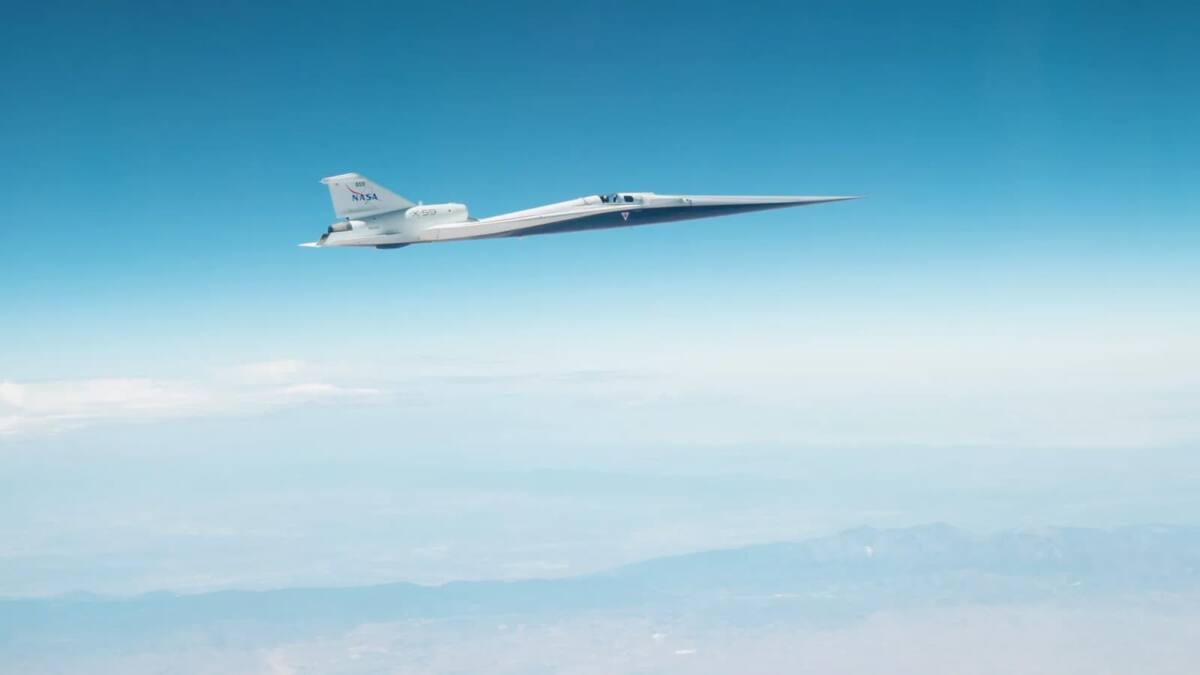
NASA’s X-59 has just cleared another milestone in its quest to make supersonic flight less obnoxious. On 12 June, the experimental aircraft reached Mach 1.4, or about 1,487 km/h, and climbed to roughly 16.8 km, putting it into the flight conditions the agency wants to study next.
The aircraft is the centerpiece of NASA’s Quesst program, which aims to prove that a supersonic jet can fly without the usual thunderclap that has kept commercial overland supersonic travel off-limits. That is the whole point here: not just going fast, but going fast without annoying everyone below.
X-59’s latest flight profile
This test came only days after the X-59 completed its first supersonic flight at Mach 1.1, or 1,147 km/h. The new run was designed to push the aircraft closer to the conditions NASA wants for its planned research campaign, rather than simply celebrating another speed record.
For now, the X-59 is flying with a NASA F-15 escort aircraft, which measures shock waves and studies how air moves around the experimental jet. The catch is that the F-15 produces its own sonic boom, so NASA is not yet using these flights to judge the X-59’s noise signature. That’s sensible, if slightly frustrating: you need a noisy helper to test the quiet aircraft.
The acoustic tests come next
After the flight envelope work is done, NASA will move into acoustic validation. That is where the real promise of the X-59 gets tested: whether it creates a softer ”sonic thump” instead of the punishing boom associated with legacy supersonic aircraft.
If those tests go well, NASA plans to fly the X-59 over several U.S. cities and gather public feedback from residents. The data will then feed into regulators and the aviation industry, which have spent decades trying to reopen the door to commercial supersonic travel over land without turning every town along the route into a noise complaint.
Why the X-59 could matter for passenger jets
NASA sees X-59 as more than a science demo. The agency wants it to help define the rules for a new generation of passenger aircraft that could cut travel times dramatically while keeping noise low enough for public acceptance. That is the real prize, and also the hard part: engineering the airplane is easier than convincing the world to let it fly overhead.
For now, the X-59 is doing exactly what NASA built it for: moving from raw speed toward proof that supersonic flight over land can be quiet enough to matter.