

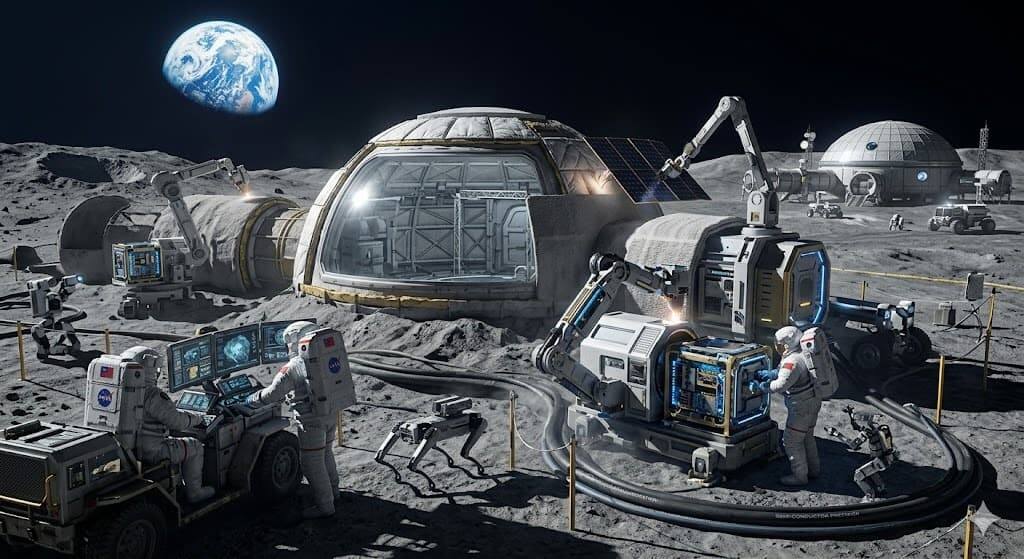
NASA has officially invited Taiwan into the orbit of its Artemis lunar program, and for the local industry this is more than a polite gesture. The move gives Taiwanese space companies a direct path to a request for technologies for future lunar infrastructure – from automation to computing systems that can survive vacuum, radiation and the Moon’s weak gravity.
It is not a contract or a tender, but a Request for Information, and in space industry terms that often matters more than a press release. At this early stage, NASA uses RFI responses to size up the market, see who can actually solve the problems, and shape the procurement programs that may follow.
For Taiwan, it is a chance to move out of the role of a quiet second-tier subcontractor and into the supply chain without intermediaries. In Tainan, Taipei and other tech hubs, the message is clear: if the island already makes advanced electronics, why not sell them directly to the companies building a lunar base?
What NASA wants for Artemis
The agency is looking for solutions to 32 technical challenges in the Artemis program. Priority areas include infrastructure, autonomous systems and computing technologies for space operations – in other words, everything a permanent lunar base would need to be more than a glossy presentation.
Artemis, which NASA is developing with international partners and private companies, aims to return humans to the Moon by 2028 and establish a permanent base by 2030. On paper, the timeline looks ambitious, but programs like this often come down to suppliers: who can deliver more reliably, more cheaply and without unnecessary heroics.
Why Taiwan sees this as its chance
Taiwan Space Agency head Wu Jong-shin says the island’s strongest areas are semiconductors and precision engineering. That sounds almost routine, but for a lunar base those capabilities are exactly what matters: the more automation there is, the more specialized chips and control systems are needed in an environment where nobody can run out and fix the wiring by hand.
According to TASA, Taiwan’s space industry already generates about $9.5 billion a year. For the government, participation in Artemis is not just about prestige, but also a bid to get into the emerging lunar economy, where the winners are the ones that join the supply chain first.
- Format: Request for Information, not a tender
- Scope: 32 technical challenges
- Artemis targets: humans on the Moon by 2028, a base by 2030
- Taiwan’s key strengths: chips, automation and precision engineering
A US bill could deepen the tie-up
Another possible route is the Taiwan-America Space Assistance Act, which is being considered in the US Congress. It would enable more direct cooperation between TASA, NASA and NOAA on satellites, space research and atmospheric science – a sign that this is less a one-off gesture than a gradual integration of Taiwan into the American space ecosystem.
If that does happen, Taiwan could gain a rare opportunity to sell not only components, but also systems integration. For the island’s industry, that would be a much bigger step up: less of a ”back-up supplier” role, more of a chance to become indispensable to a lunar project.
Who benefits if NASA goes further
The first gains will likely go to companies that can quickly adapt terrestrial technologies to the brutal conditions of space. But the more interesting question is whether this RFI becomes a durable channel for Taiwanese suppliers, or ends as another polite ”thanks, we’ll remember you.”