


Moscow has kicked off Russia’s first industrial production of liquid crystal display (LCD) modules at the Technopolis Moscow special economic zone, city mayor Sergey Sobyanin announced. Alongside the display line, a second production line started rolling out optical transceivers based on photonic integrated circuits-key components for data centers, banks, and telecom operators.
The new LCD line produces screens ranging from 11 to 86 inches. These panels aren’t just for consumer gadgets; they’re used in train cabins, medical monitors, banking terminals, elevator control panels, and industrial automation systems. Once operating at full capacity, the factory aims to output around 500,000 LCD modules per year-meeting roughly half of the demand in Russia’s Central Federal District.
While local assembly of LCD screens is a milestone, the scale is what really stands out. Until now, Russia imported most of its LCD modules from abroad, primarily Asia, where the vast majority of global LCD manufacturing is concentrated. Industry giants like China’s BOE and TCL CSOT churn out tens of millions of panels annually. In comparison, Moscow’s facility is niche, but it marks a significant shift for Russia’s industrial electronics sector by providing homegrown supply to domestic transport, medical, and terminal equipment makers.
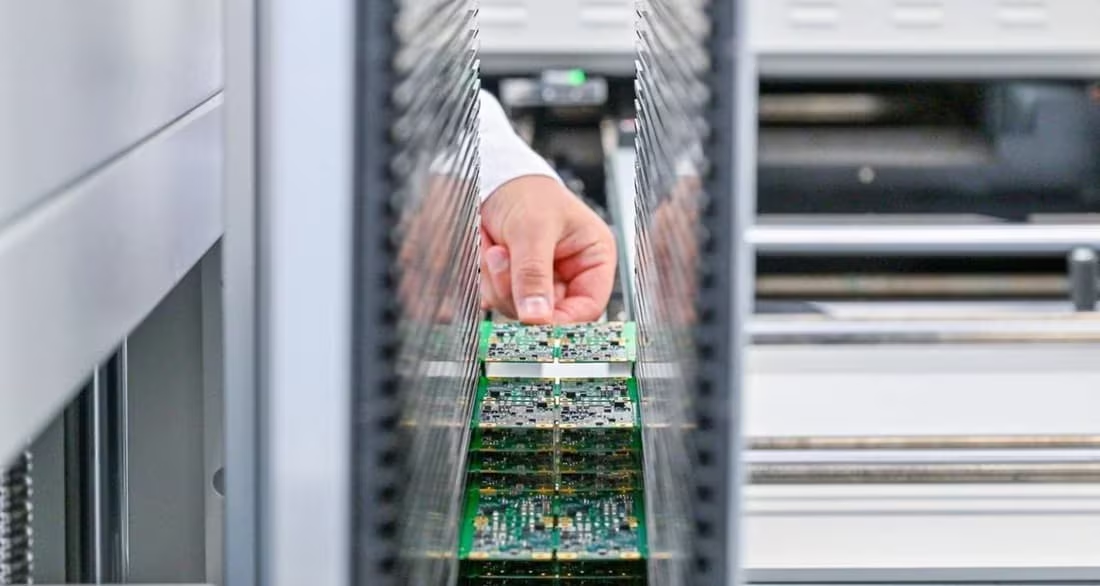
The optical transceiver line on the same site focuses on telecom and data center infrastructure. It produces high-speed transceivers supporting 400 Gb/s and 800 Gb/s speeds-currently the backbone standards for data centers and backbone networks. Globally, leading cloud providers are already moving toward 1.6 Tb/s speeds for AI clusters, putting the Moscow factory in a fast-growing segment that outpaces traditional telecom demand.
Private investors poured about 7.2 billion rubles (roughly $95 million) into both production lines, which have created nearly 400 jobs so far. This initiative aligns with Moscow’s broader push to localize electronic components manufacturing. Since 2022, critical parts like LCD displays and telecom modules have posed more pressing supply chain challenges for Russian device assemblers than finished products themselves.
The factory’s future hinges on two factors: deepening localization and consistent demand. If it reaches the planned output of 500,000 LCD modules per year, it will become one of Russia’s leading B2B screen suppliers. The transceiver line may show results sooner, as ongoing upgrades to Russian data center and telecom networks rely on 400G technology-which has already become standard in new infrastructure projects.
Compared to global heavyweights, Moscow’s production is small but strategic. It reduces dependency on Asian imports, supports critical infrastructure sectors, and could catalyze growth in Russia’s industrial electronics ecosystem. The next step to watch is how the factory scales its domestic supply chains amid fluctuating demand and how it competes with established international players in quality and volume.