

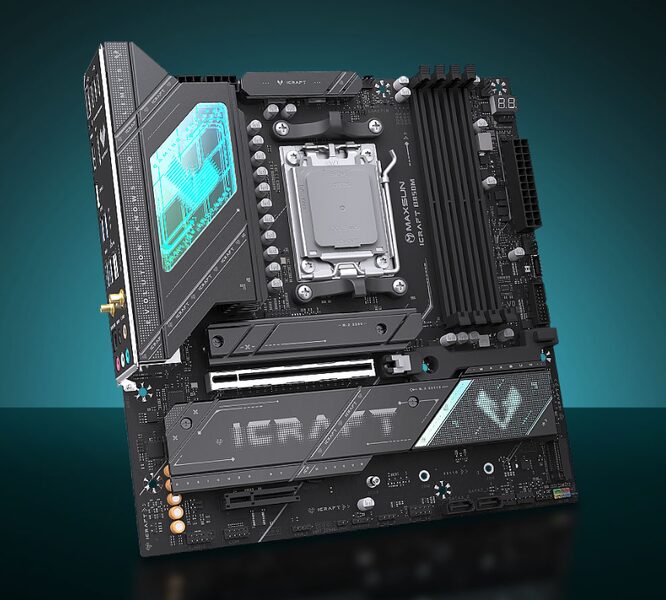
Maxsun has pushed two new Micro ATX gaming motherboards into its B850 lineup, and the company is making a simple bet: builders will pay attention if the board makes life easier. The MS-iCraft B850M WIFI and MS-iCraft B850M GKD5 WIFI both target AMD systems with PCIe Gen5, Wi-Fi 6E, and a physical button for releasing the graphics card, a small touch that could save a few scraped knuckles during upgrades.
That kind of convenience has become a quiet selling point in enthusiast hardware. A growing number of boards now hide their premium features under polished heatsinks and RGB lighting, but the parts people actually touch – slots, latches, headers – are still where many designs feel annoyingly old-fashioned.
Maxsun MS-iCraft B850M WIFI specs
The two boards share the same basic platform: Skylight RGB aluminum heatsinks, a 10+2+1 power setup, support for up to 250 W, two PCIe slots, and three M.2 connectors. Two of those M.2 slots run through PCIe Gen5, while networking includes 5GbE Ethernet and Wi-Fi 6E. Around the back, there is USB-C at 10 Gbps, and the front panel gets USB-C at 20 Gbps.
DDR5-8000 versus DDR5-8800
Where Maxsun splits the pair is memory. The MS-iCraft B850M WIFI uses four DIMM slots and is rated for DDR5-8000, which is already plenty fast for most buyers and likely easier to live with if you want more capacity later. The GKD5 WIFI takes the narrower, more overclocking-friendly route with two DIMM slots, a 110 A DrMOS power design, and claimed DDR5-8800 support.
That trade-off is familiar in the motherboard world: higher memory ceilings usually come with fewer slots, because chasing speed and keeping signal integrity happy often means making sacrifices elsewhere. MSI, ASUS, and Gigabyte all play the same game on their higher-end AM5 boards; Maxsun is just advertising the compromise more bluntly than most.
A small button with a very large audience
The headline feature is still the quick-release button for the graphics card. Instead of fumbling for a PCIe latch that may be tucked under a huge GPU cooler, users press a physical button positioned where fingers can actually reach it. That is less glamorous than another RGB zone, but far more useful the first time someone needs to swap a card without turning the whole case into a disassembly tutorial.
Maxsun has not said how much either board will cost, and that detail will decide whether this is a clever enthusiast move or just another spec sheet flex. If pricing lands aggressively, the GKD5 WIFI in particular could find an audience among builders chasing high-speed DDR5 without jumping to a larger, pricier platform.