

The move fits Huawei’s broader playbook: push premium hardware, then wrap it in software and services that make it harder for rivals to copy the package. Lenovo, Dell, and HP have all spent years selling business laptops on manageability and security rather than raw specs, so Huawei is clearly trying to meet enterprise buyers on their own turf.
Why Huawei is targeting corporate and government users
That focus on control matters. Government agencies and large firms tend to care less about the novelty of a folding screen than about auditing, account isolation, and whether a device can be locked down properly. Huawei is betting that a distinctive form factor plus a hardened software layer will be enough to make the MateBook Fold feel less like a gadget and more like infrastructure.
The open question is whether that is enough to move buyers who already have entrenched fleets from established PC vendors. If Huawei can pair the Fold’s hardware novelty with credible enterprise administration, it has a niche. If not, this remains an eye-catching concept dressed up in IT language – which, to be fair, is still more useful than most concept laptops manage.
The move fits Huawei’s broader playbook: push premium hardware, then wrap it in software and services that make it harder for rivals to copy the package. Lenovo, Dell, and HP have all spent years selling business laptops on manageability and security rather than raw specs, so Huawei is clearly trying to meet enterprise buyers on their own turf.
Why Huawei is targeting corporate and government users
That focus on control matters. Government agencies and large firms tend to care less about the novelty of a folding screen than about auditing, account isolation, and whether a device can be locked down properly. Huawei is betting that a distinctive form factor plus a hardened software layer will be enough to make the MateBook Fold feel less like a gadget and more like infrastructure.
The open question is whether that is enough to move buyers who already have entrenched fleets from established PC vendors. If Huawei can pair the Fold’s hardware novelty with credible enterprise administration, it has a niche. If not, this remains an eye-catching concept dressed up in IT language – which, to be fair, is still more useful than most concept laptops manage.
The move fits Huawei’s broader playbook: push premium hardware, then wrap it in software and services that make it harder for rivals to copy the package. Lenovo, Dell, and HP have all spent years selling business laptops on manageability and security rather than raw specs, so Huawei is clearly trying to meet enterprise buyers on their own turf.
Why Huawei is targeting corporate and government users
That focus on control matters. Government agencies and large firms tend to care less about the novelty of a folding screen than about auditing, account isolation, and whether a device can be locked down properly. Huawei is betting that a distinctive form factor plus a hardened software layer will be enough to make the MateBook Fold feel less like a gadget and more like infrastructure.
The open question is whether that is enough to move buyers who already have entrenched fleets from established PC vendors. If Huawei can pair the Fold’s hardware novelty with credible enterprise administration, it has a niche. If not, this remains an eye-catching concept dressed up in IT language – which, to be fair, is still more useful than most concept laptops manage.
The move fits Huawei’s broader playbook: push premium hardware, then wrap it in software and services that make it harder for rivals to copy the package. Lenovo, Dell, and HP have all spent years selling business laptops on manageability and security rather than raw specs, so Huawei is clearly trying to meet enterprise buyers on their own turf.
Why Huawei is targeting corporate and government users
That focus on control matters. Government agencies and large firms tend to care less about the novelty of a folding screen than about auditing, account isolation, and whether a device can be locked down properly. Huawei is betting that a distinctive form factor plus a hardened software layer will be enough to make the MateBook Fold feel less like a gadget and more like infrastructure.
The open question is whether that is enough to move buyers who already have entrenched fleets from established PC vendors. If Huawei can pair the Fold’s hardware novelty with credible enterprise administration, it has a niche. If not, this remains an eye-catching concept dressed up in IT language – which, to be fair, is still more useful than most concept laptops manage.
- 18-inch foldable display
- Kirin X90 system-on-chip
- HarmonyOS V1.0 based on HarmonyOS 6
- User and device management tools
- AI modules and stronger security controls
- Separate intranet and external network workspaces
The move fits Huawei’s broader playbook: push premium hardware, then wrap it in software and services that make it harder for rivals to copy the package. Lenovo, Dell, and HP have all spent years selling business laptops on manageability and security rather than raw specs, so Huawei is clearly trying to meet enterprise buyers on their own turf.
Why Huawei is targeting corporate and government users
That focus on control matters. Government agencies and large firms tend to care less about the novelty of a folding screen than about auditing, account isolation, and whether a device can be locked down properly. Huawei is betting that a distinctive form factor plus a hardened software layer will be enough to make the MateBook Fold feel less like a gadget and more like infrastructure.
The open question is whether that is enough to move buyers who already have entrenched fleets from established PC vendors. If Huawei can pair the Fold’s hardware novelty with credible enterprise administration, it has a niche. If not, this remains an eye-catching concept dressed up in IT language – which, to be fair, is still more useful than most concept laptops manage.
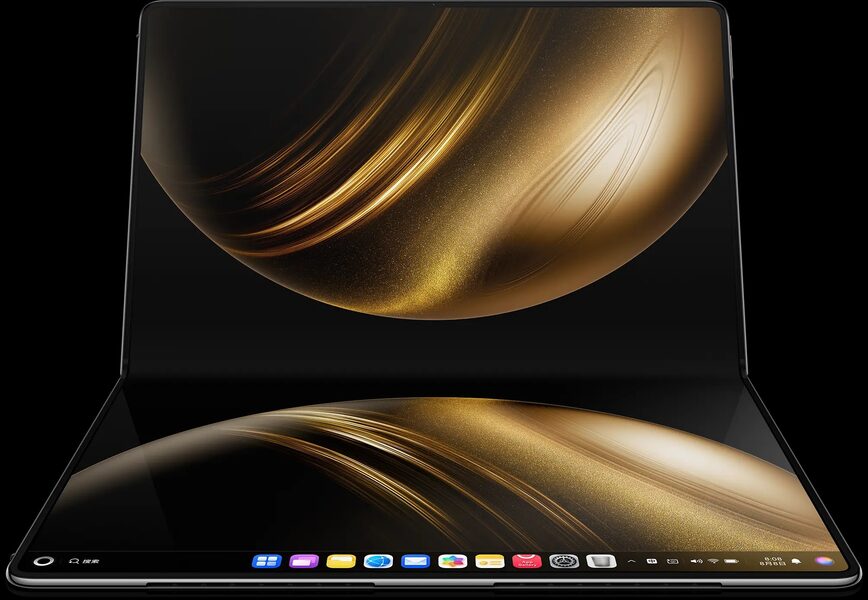
Huawei has turned its 18-inch foldable MateBook Fold PC into a business-facing machine, swapping the consumer pitch for an Enterprise Edition aimed at companies and government buyers. The hardware stays the same – same Kirin X90 platform, same folding screen – but the software stack gets a serious overhaul, which is the part enterprises actually care about. Huawei MateBook Fold now runs HarmonyOS V1.0 for enterprise users.
The headline change is HarmonyOS V1.0, a version built on HarmonyOS 6 and tuned for corporate use. It adds user and device management tools, AI modules, and tougher data protection and hardware certification features. In other words, Huawei is trying to make the Fold look less like a flashy demo device and more like something a procurement department could sign off on without flinching.
HarmonyOS V1.0 features for enterprise buyers
Huawei says the Enterprise package includes authentication kits, corporate account and device management, and information security tools. It also supports separate work environments for intranet and external networks, a setup that will sound familiar to anyone who has ever sat through an IT security briefing and nodded politely.
- 18-inch foldable display
- Kirin X90 system-on-chip
- HarmonyOS V1.0 based on HarmonyOS 6
- User and device management tools
- AI modules and stronger security controls
- Separate intranet and external network workspaces
The move fits Huawei’s broader playbook: push premium hardware, then wrap it in software and services that make it harder for rivals to copy the package. Lenovo, Dell, and HP have all spent years selling business laptops on manageability and security rather than raw specs, so Huawei is clearly trying to meet enterprise buyers on their own turf.
Why Huawei is targeting corporate and government users
That focus on control matters. Government agencies and large firms tend to care less about the novelty of a folding screen than about auditing, account isolation, and whether a device can be locked down properly. Huawei is betting that a distinctive form factor plus a hardened software layer will be enough to make the MateBook Fold feel less like a gadget and more like infrastructure.
The open question is whether that is enough to move buyers who already have entrenched fleets from established PC vendors. If Huawei can pair the Fold’s hardware novelty with credible enterprise administration, it has a niche. If not, this remains an eye-catching concept dressed up in IT language – which, to be fair, is still more useful than most concept laptops manage.