

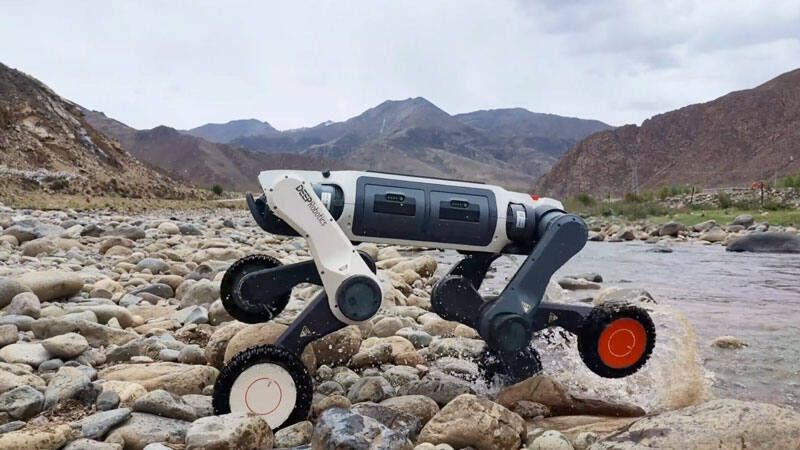
DEEP Robotics has put its reinforced Lynx M20S robot dog through a far nastier test than most marketing demos can handle: mountain slopes around 1,000 meters up, deep snow, ice, and temperatures down to −30 °C. The headline result is simple: the hybrid quadruped kept moving, which is exactly what you want from a machine aimed at rescue, inspection, and scientific work in places that laugh at human comfort.
The Lynx M20S robot dog is trying to prove that field robots can do more than look good on a lab floor. Its hybrid design mixes wheels and legs, so it can roll efficiently on flat ground and step carefully when the terrain turns ugly.
Hybrid wheels and legs for rough terrain
Lynx M20S belongs to the hybrid class of quadruped robots: its feet end in wheels. On even surfaces it behaves more like a four-wheeled platform, saving energy and keeping up speed. When the ground turns into rocks, stairs, or slush, it switches to legged movement to reposition its body, clear obstacles and stay balanced.
DEEP Robotics says the machine can handle stairs with steps up to 25 cm high, single obstacles up to 80 cm, and slopes of up to 45°. That is the kind of spec sheet that sounds optimistic until you remember how many warehouse robots panic at a cable.
Lynx M20S robot dog range, payload and battery life
With batteries installed, the robot weighs about 35 kg. It can carry useful loads of up to 15 kg for longer missions, and it can briefly haul as much as 50 kg. In autonomous mode with no cargo, it runs for up to three hours and covers up to 15 km.
- Unloaded runtime: up to three hours
- Unloaded range: up to 15 km
- With 15 kg load: 2.5 hours and about 12 km
- Charge time: about 1.5 hours
- Top working speed: 2 m/s, or up to 5 m/s on flat ground
The battery setup also supports hot swapping, which is the sort of practical detail that makes a robot useful outside a demo hall. If a field team can swap packs instead of waiting around, the machine becomes an asset rather than a very expensive coffee break.
Sensors, protection and cold-weather proofing
For navigation, Lynx M20S uses two 96-line LiDAR units with 360° × 90° coverage, plus wide-angle cameras and lights on both sides. The body carries an IP66 rating for dust and water protection, and it can cross water up to 80 cm deep.
DEEP Robotics lists the operating temperature range as −20 °C to +55 °C, but the mountain test pushed beyond that lower bound and still ended with the robot moving through 30 degrees of frost. That extra headroom is the sort of proof buyers will care about, because the real world has never been generous to neat specifications.
Where robots like this may go next
The likely winners here are emergency crews, infrastructure inspectors, and research teams that need something sturdier than a drone and less dramatic than sending a person in first. The bigger question is whether this class of robot can move from impressive trail footage to routine deployment, where uptime, maintenance and battery swaps matter more than a viral clip of it climbing a snowy ridge.