

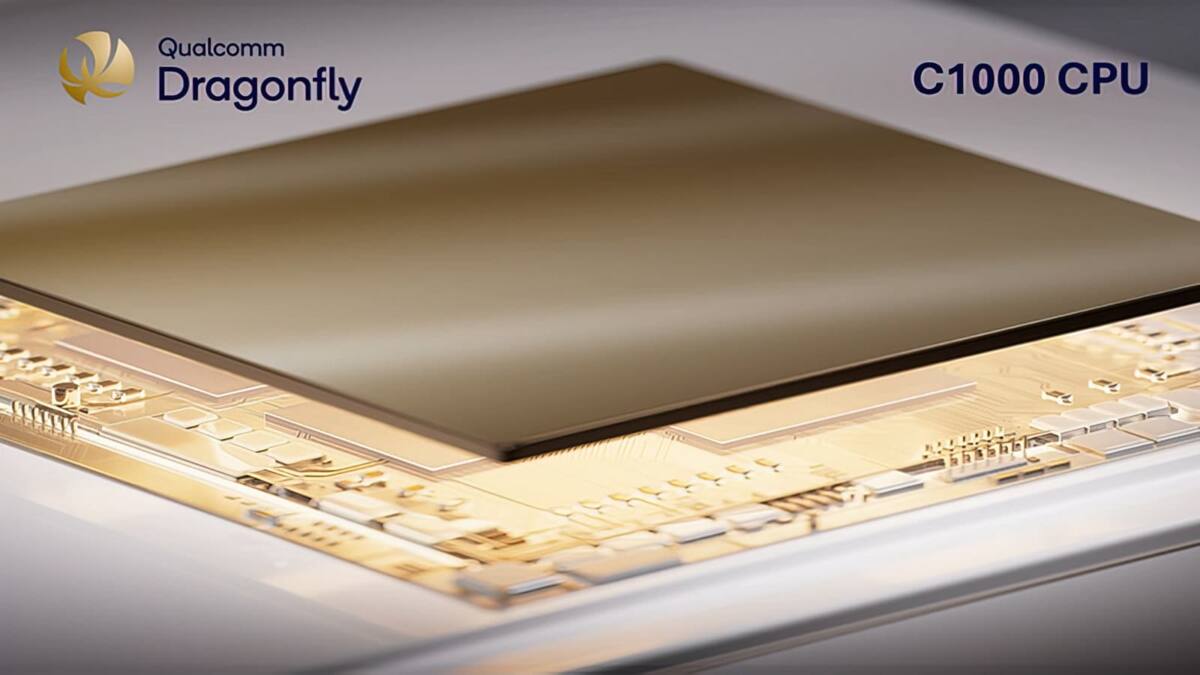
Qualcomm has finally made the server push that’s been rumored for years: Dragonfly C1000 is its first data center processor, built on the company’s custom Oryon architecture and aimed at both AI agents and general-purpose workloads. The headline numbers are the kind that make Intel Xeon and AMD EPYC pay attention – more than 250 cores, frequencies above 5.0 GHz, and a pitch around better performance per watt than current market options.
The move lands in a server CPU market Qualcomm says is worth about $200 billion, still dominated by x86 but with ARM quietly taking more of the table. That makes Dragonfly less of a side project and more of a direct attempt to win a slice of the infrastructure spend that powers the AI boom, where efficiency has become as valuable as raw speed. If Qualcomm can make the numbers hold up outside the slide deck, the pricing pressure on incumbents could get unpleasant fast.
Dragonfly C1000 core count and performance claims
Qualcomm says the main compute module in Dragonfly C1000 can scale beyond 250 cores, and that the chip is designed as a multi-chiplet part using advanced packaging. The company is also claiming class-leading single-thread performance and clock speeds above 5.0 GHz, a combination that is meant to reassure buyers who still think ”ARM server chip” means compromise. That may be true on paper, but the real test will be whether those frequencies survive actual rack-scale workloads without turning the power budget into a joke.
- More than 250 cores in the main compute module
- Clock speeds above 5.0 GHz
- About 2x better performance per watt versus current market solutions, according to Qualcomm
PCIe Gen7, CXL, and HBC memory support
On the platform side, Qualcomm is stacking up the connectivity. Dragonfly C1000 supports PCIe Gen7 with more than 2 TB/s of bandwidth, along with CXL and the company’s High Bandwidth Compute memory technology. Qualcomm says HBC is meant to help with the memory bottleneck and can deliver up to six times the bandwidth per watt compared with HBM. That is a bold claim in a category where memory bandwidth is often the difference between a chip that looks fast and one that actually is fast.
Competitors are already heading in the same direction, just from different angles: AMD has spent years pushing EPYC into hyperscale, while Intel is trying to defend Xeon with higher density and tighter platform integration. Qualcomm’s bet is that AI-centric data centers care enough about efficiency and memory economics to give a mobile-chip veteran a serious hearing.
2028 rollout and OCP ORv2 racks
The first Dragonfly C1000 server racks are expected in 2028, with both air-cooled and liquid-cooled versions planned, and they will follow the OCP ORv2 standard. Mass production is scheduled to begin in the second half of 2028. That timeline gives Qualcomm a long runway, but also plenty of time for rivals to sharpen their own server roadmaps – which is exactly what you get when entering a market that moves on power, packaging, and procurement cycles instead of launch-day applause.
The open question is not whether Qualcomm can build a capable chip; it clearly can. It is whether cloud buyers will trust a first-generation server platform from a company that has spent most of its life elsewhere, and whether Dragonfly arrives soon enough to matter in a market already being reshaped by custom silicon and ARM adoption.