

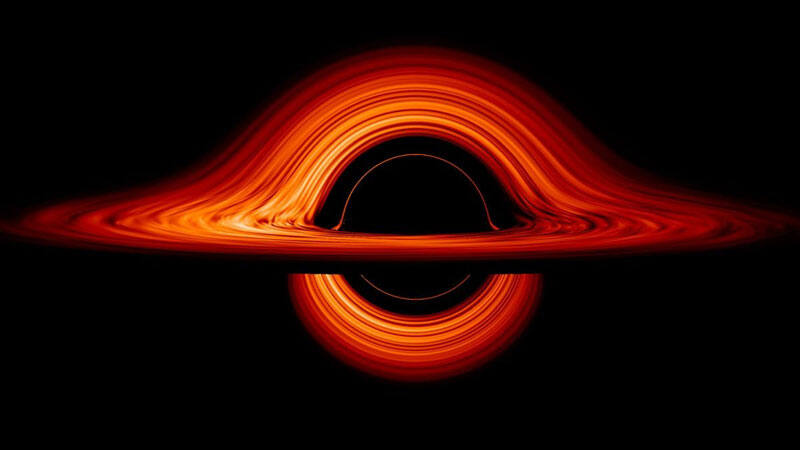
For years, the event horizon of a black hole lived mostly on whiteboards: a neat boundary defined by equations, not something anyone could point to in the sky. Now researchers say gravitational-wave data from the LIGO black hole merger GW250114 may have exposed a more direct signature of that edge, hinting at physics right next to the point of no return.
The claim comes from one of the loudest gravitational-wave mergers yet studied, GW250114, recorded on 14 January 2025 by the two US LIGO interferometers in Hanford and Livingston. The signal came from two black holes of roughly equal mass, each about 30 to 40 times the mass of the Sun, that merged into a spinning remnant. The usual post-merger ”ringing” was there, but the team says it also pulled out a subtler component: a fast-fading direct wave that may come from the chaotic region near the horizon itself.
What GW250114 showed
In the standard picture, a black hole left behind after a merger emits gravitational waves at specific frequencies set by its mass and spin, much like a bell after a strike. That is the realm of quasinormal modes, the familiar ”ringdown” signal physicists have been measuring for years. The new analysis suggests there may also be a cleaner, more immediate wave packet riding on top of that ringdown, one that would be tied to conditions almost at the horizon.
The proposed direct signal is supposed to sit near twice the black hole’s rotation frequency and die away quickly because of extreme redshift and the brutal gravitational environment around the horizon. That is a bold claim, and not a settled one: gravitational-wave astronomy does not observe raw events directly so much as match detector data against supercomputer-generated templates. Still, if the feature survives scrutiny, it would give astronomers a way to probe not just the settled aftermath of a merger, but the near-horizon zone that has largely remained theoretical.
Why the horizon is hard to pin down
This is where the story gets interesting for black hole physics. The horizon itself cannot be seen in the ordinary sense, and until now its existence was inferred indirectly from mass, spin, and the way merged black holes ”sang” after collision. A detector-based hint of horizon-adjacent behavior would not make the boundary a photographable object, but it would move the field closer to testing general relativity in one of its most extreme regimes.
- Event: GW250114
- Detection date: 14 January 2025
- Detectors: LIGO Hanford and Livingston
- Source: two black holes, each about 30 to 40 solar masses
- Expected signal: quasinormal-mode ringdown plus a proposed direct wave
What happens if the signal holds up
The sensible next step is repetition. One detection is intriguing; several similar cases would be persuasive. If future mergers show the same short-lived component, the horizon may finally become something physicists can probe experimentally rather than just define elegantly. If not, GW250114 will still stand as a reminder that black holes are getting harder to hide behind pure theory.