

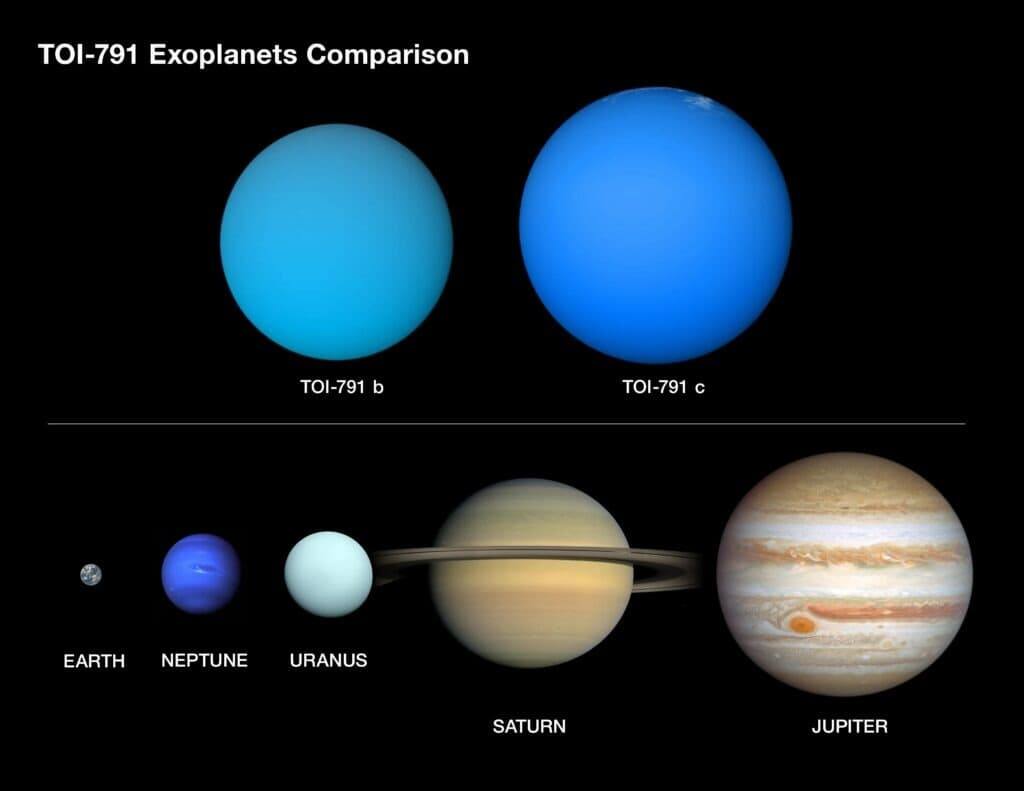
NASA’s TESS telescope has turned up a system that looks almost fake on paper: two exoplanets, TOI-791 b and TOI-791 c, each about the size of Jupiter but so light they belong in the ”super-puffy” club, a class of gas giants with densities low enough to invite the sugar-cotton comparison. Both orbit a Sun-like star about 1,113 light years from Earth, and together they give astronomers a rare chance to watch two oddly inflated worlds share the same neighborhood.
The headline numbers are the kind that make planetary scientists sit up straighter. TOI-791 b is roughly Jupiter-sized but has only about 3% of Jupiter’s mass, while TOI-791 c is even larger in diameter and still reaches just 5.9% of Jupiter’s mass. That is not a rounding error; it is a giant atmosphere with almost nothing underneath, and it immediately pressures models that try to explain how gas giants form and stay intact.
Two planets, one star, very little heft
TESS found the pair the way it finds most exoplanets: by watching a star dim ever so slightly when a planet crosses in front of it. The first pass only reveals a candidate, but the follow-up analysis here confirmed two large objects with unusually low density. One practical wrinkle is that long-orbit planets are easier to miss, which makes a system with two such worlds around a single star especially valuable rather than just weird for the sake of weird.
- TOI-791 b: Jupiter-sized, about 3% of Jupiter’s mass
- TOI-791 c: larger than Jupiter in diameter, 5.9% of Jupiter’s mass
- Host star: Sun-like, about 1,113 light years away
- Orbital periods: 139 days for TOI-791 b, 232 days for TOI-791 c
Why the timing data mattered
What really sharpened the result was the way the two planets tug on each other. Their mutual gravity alters the timing of their transits, and those tiny shifts let researchers estimate masses that would otherwise be much harder to pin down. It is a neat reminder that exoplanet science often works less like photography and more like detective work with a stopwatch.
That also explains why this system stands out beyond the novelty factor. Long-period planets are harder to catch because they require extended, uninterrupted monitoring, and yet TOI-791 b and c both revealed themselves through a chain of timing clues. The rarity is not just in their bloated bodies but in the fact that two of them showed up around the same star at all.
A laboratory for giant-planet physics
Researchers now want to know how atmospheres this large can survive with so little mass, what their chemistry looks like, and whether migration through the system helped place them where they are now. Systems like TOI-791 are exactly the sort of test case that can expose where current formation models are too tidy. If gas giants can come in this dilute, the theory notes need more than a minor edit.
The next step is obvious: study the atmospheres in more detail and see whether these worlds are oddballs or just the first clear examples of a much broader population. My bet? TESS has not found the last of these floating giants; it has merely made the rest easier to recognize.