

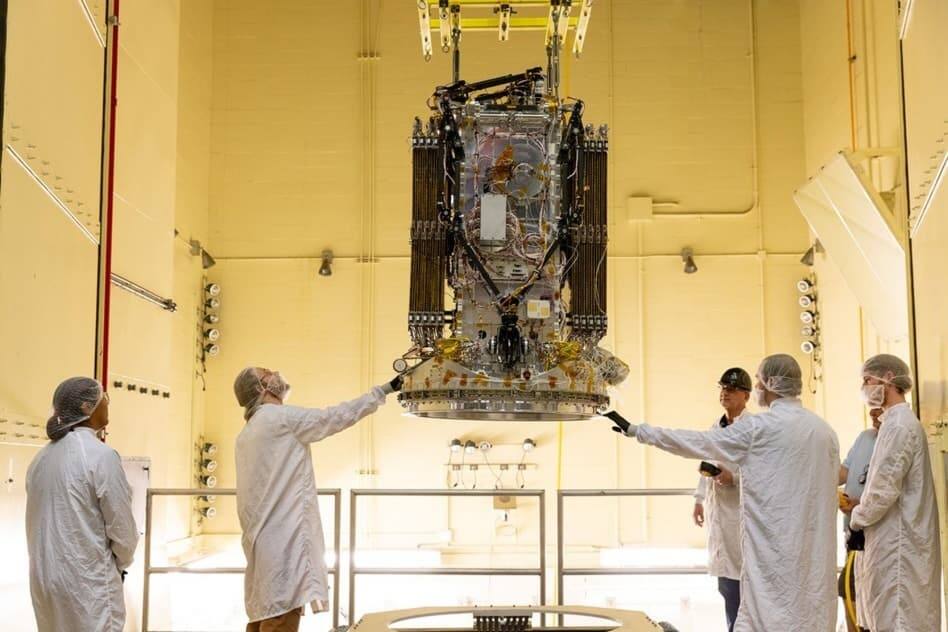
Katalyst Space has raised $12 million to build NEXUS, its first robotic spacecraft for satellite servicing in geostationary orbit. The company is also preparing a nearer-term demo this month: LINK, backed by a $30 million NASA contract, is set to dock with the Swift observatory and raise its orbit before the telescope would otherwise fall back toward Earth.
The contrast is telling. Space hardware is increasingly being sold not as a one-off ride to orbit, but as a service layer that can extend life, move assets, and do work already in space. That shift is drawing money across the sector, from satellite life extension to in-orbit refueling and reusable transport vehicles.
NEXUS builds on the LINK platform
According to Katalyst, NEXUS is an evolution of LINK with the same autonomous rendezvous and docking capabilities, but with roughly double the power, mass, and Delta-V, the measure of how much orbital maneuvering reserve a spacecraft has. The demo mission is slated for 2027 and will ride to geostationary orbit on Ariane 6 from Arianespace.
That matters because GEO is crowded, valuable, and expensive to serve. A vehicle that can move there once and then handle multiple customers in a single mission has a much cleaner business case than the old ”launch it and leave it” model.
Swift gets a lift this month
LINK is scheduled to launch on 27 June aboard Northrop Grumman’s Pegasus XL, carried aloft by the Stargazer aircraft. Its job is straightforward but unusual: dock with NASA’s Swift gamma-ray observatory and push it into a higher orbit so the spacecraft does not reenter Earth’s atmosphere before the end of the year.
That kind of mission is the most practical proof that orbital servicing is moving from theory to operations. NASA and commercial operators have both spent years talking up satellite refueling and repairs; the difference now is that companies are trying to turn those ideas into repeatable revenue.
Orbit becomes a logistics business
Katalyst’s chief executive Ghonhee Lee says the longer-term play goes well beyond keeping satellites alive. The company wants to target orbital data centers and even infrastructure work on the Moon, where robots that can manipulate hardware in space could become a basic utility rather than a novelty.
It is a crowded field already. Instinct Space, based in New Zealand and the Netherlands, has shifted away from lunar navigation support toward surface operations and is using its funding for the Aurora spaceplane and in-orbit refueling demos. Dawn Aerospace, also split between New Zealand and the Netherlands, recently closed a $25 million Series B at a $195 million post-money valuation for the same broad bet: reusable, serviceable systems instead of single-shot missions.
- Katalyst Space funding: $12 million
- NEXUS demo mission: 2027
- Launch vehicle: Ariane 6
- LINK launch date: 27 June
- LINK customer mission: NASA’s Swift observatory
The real race is not just who can launch the most hardware, but who can keep that hardware useful after launch. If Katalyst can make satellite servicing routine, the next wave of orbital infrastructure may look less like a fleet of isolated machines and more like a working network with mechanics built in.