

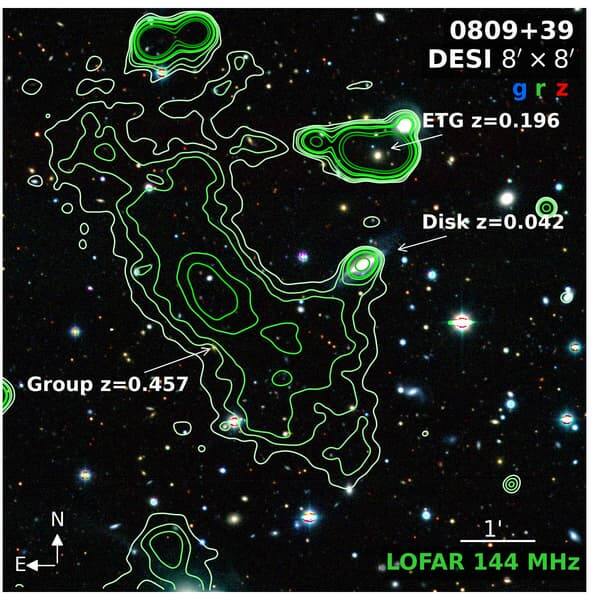
Astronomers have spotted J1248+4826, the smallest odd radio circle yet found. The object sits in a galaxy group and has a central radio ring just 30 kiloparsecs across, about five times smaller than the usual examples. The find suggests researchers may have been missing a whole population of compact ORCs, not because they do not exist, but because search tools were tuned to look for bigger, cleaner targets.
The discovery came from the LoTSS sky survey and was led by Maria Polletta of Italy’s National Institute for Astrophysics. What makes this one awkwardly interesting is its structure: a tight inner ring wrapped in a diffuse outer shell stretching to 100 kiloparsecs. That is not the signature of a fresh black hole outburst or a supernova remnant. It looks more like old plasma being lit back up by outside pressure, which is a neat way for the universe to recycle its trash.
A compact odd radio circle hidden inside a larger glow
LOFAR, the low-frequency radio array used in the study, picked up emission that is basically invisible at higher frequencies. The team combined those radio maps with archival images from Spitzer and the DESI survey to pin down the object’s environment. J1248+4826 sits inside a dynamically active group of 11 galaxies at redshift z ~0.2, not in some lonely corner of space where the usual tidy explanations tend to work.
The strangest clue is where the likely parent galaxy is sitting. In most known odd radio circles, the host galaxy sits near the middle. Here it is pushed off toward the edge, which makes a simple central explosion look unlikely. One plausible explanation is that a shock wave with a Mach number between 2.0 and 3.3 raced through the intergalactic medium, slammed into a bubble of ancient plasma, and reshaped it into a ring. Think of a smoke ring getting kicked back into focus, only on galaxy-group scales.
Why compact odd radio circles matter
For astronomers, this is less a curiosity than a warning label on the search process. If algorithms mostly catch the biggest, brightest examples, then the census of radio circles has been biased from the start. That matters because these structures may be relics of past black hole activity, now revived by later shocks in the surrounding gas.
The broader payoff may come from next-generation radio facilities such as the SKA, which should make faint structures easier to map in detail. If that happens, ORCs could become more than oddities with funny names: they may turn into probes of gas density and gravitational interactions in galaxy groups far beyond the local universe. The next surprise is likely to be another one hiding in plain sight, just smaller, messier, and harder for today’s software to notice.