

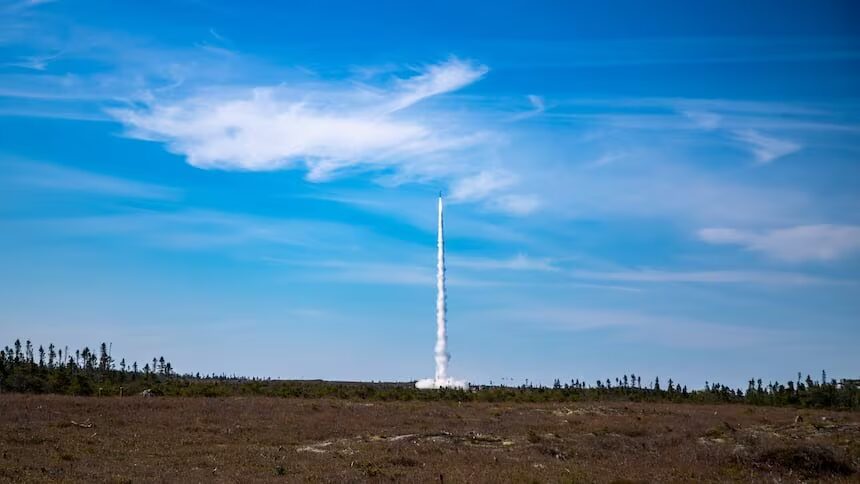
German rocket startup Isar Aerospace is skipping the usual office groundwork and diving straight into launch operations in North America. The company has inked a 10-year deal with Canadian Maritime Launch Services to construct a dedicated launch complex for its Spectrum rocket at Spaceport Nova Scotia in Canada’s Nova Scotia province. The first missions from this new site are planned for 2028, with an ambitious goal of reaching 40 launches annually by 2029.
Isar Aerospace’s Canadian launch site plans
Isar has already established a Canadian subsidiary-Isar Aerospace Canada-to handle this project, committing around $100 million to develop the launch site. Once fully operational, the spaceport operator will receive quarterly payments of $3.75 million under the agreement. At the heart of this initiative is the Spectrum rocket, a two-stage launcher designed by Isar for small and medium satellite payloads.
This will be Isar Aerospace’s second launch facility. The company’s first site is in Norway, where it plans to conduct Spectrum’s first test flight in March 2025. That initial launch ended shortly after takeoff-a familiar hiccup for new private launch vehicles, a hurdle that US and New Zealand startups have also faced. Now, Isar is branching out strategically by operating multiple launch sites across different countries.
For Canada, the deal aligns with a long-standing ambition to establish an indigenous orbital launch capability. Unlike the US or Europe, Canada currently lacks domestic launch infrastructure and relies heavily on foreign partners, particularly from the United States, to deploy satellites. In March, the federal government finalized a 10-year lease with Maritime Launch Services worth $200 million, alongside a $183 million budget allocation over three years to develop national launch facilities.
Spaceport Nova Scotia is set to become Canada’s first commercial spaceport, initially hosting four launch pads. Three are already assigned-to Isar Aerospace, the Canadian government, and domestic launch company Reaction Dynamics-while the fourth pad is still seeking a tenant. Nova Scotia aims to carve out a niche serving light launch vehicles, targeting the same market segment already occupied by Rocket Lab’s facilities in New Zealand and Virginia.
The 40 launches per year target is notably ambitious for a company still in the early stages of deploying its Spectrum rocket. Yet, if Canada is serious about establishing a native orbital launch capacity by the end of the decade, the real test will begin soon with the scheduled first launches in 2028.
As the global commercial launch industry consolidates around a handful of heavy hitters like SpaceX and Rocket Lab, newcomers like Isar Aerospace demonstrate the growing international competition in small and medium satellite launches. Watching how well Isar can scale up operations across two continents will be key for assessing if multiple, regional spaceports can thrive outside established aerospace hubs.