

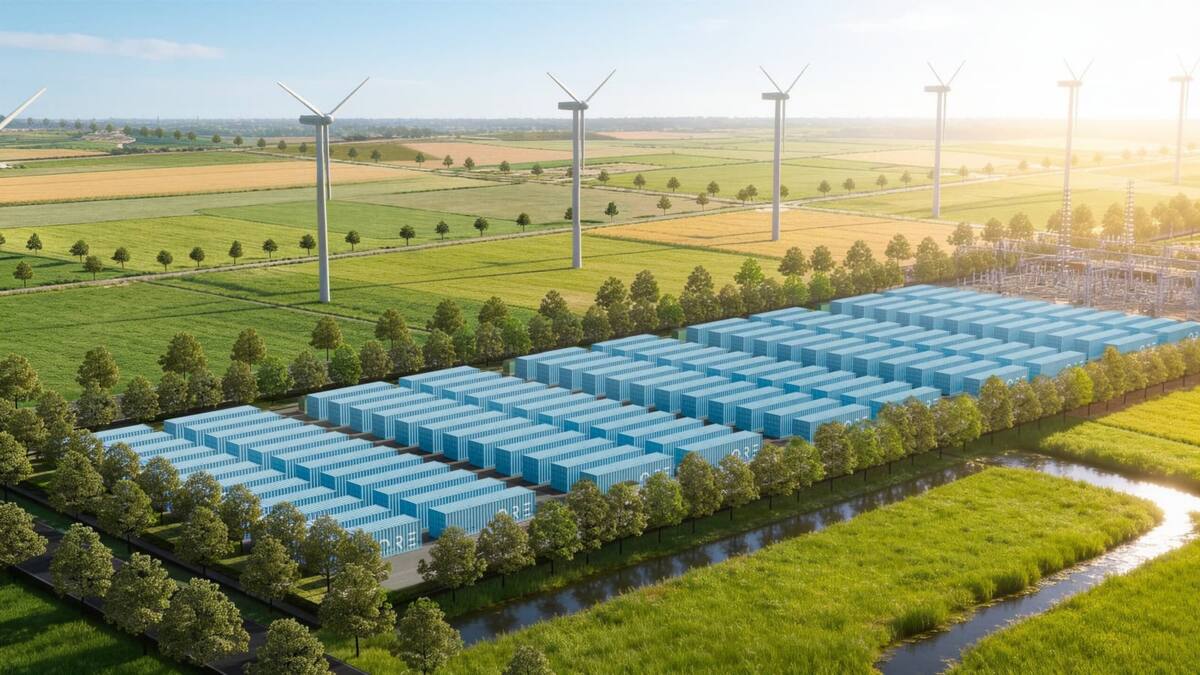
A Dutch startup and one of the Netherlands’ biggest electricity suppliers are betting that Europe’s next big storage story will not run on lithium at all. Ore Energy and Budget Thuis have agreed to deploy an iron-air battery system with a total capacity of 1 GWh, a deal that Ore Energy says will be the largest of its kind in Europe and the first between an iron-air developer and a European utility.
The answer is a long-duration iron-air battery deployment built to store surplus wind and solar power for far longer than today’s usual battery systems can manage, then feed it back when the grid is short on generation. That matters because lithium-ion is great for short bursts, but less suited to riding through several dull, windless days.
A 400 MWh first phase in 2028
The rollout will happen in stages. The first phase is set at 400 MWh and should go into operation in 2028, before the system is expanded to 1 GWh.
Ore Energy says its technology is built for long-duration storage, with discharge windows of 24 to 100 hours. In other words, this is not a fast-response battery for smoothing a few peak hours; it is a multi-day buffer designed to make renewable power behave a little more like a dispatchable plant.
Why iron-air batteries are getting attention
Iron-air batteries use iron, water, and air as their main ingredients. Ore Energy says the system contains no lithium or cobalt, is not fire-prone, and can be built entirely through European supply chains – a neat selling point at a time when energy security and industrial policy keep showing up in the same sentence.
The economic logic is also straightforward. Europe needs storage that can absorb surplus generation from wind and solar and release it during long stretches of weak output, reducing reliance on gas-fired power plants that still do much of the balancing work. If iron-air can scale, it could become the less glamorous but more useful cousin of the lithium battery boom.
Ore Energy’s earlier tests
This is not the company’s first public run at the idea. Ore Energy has already tested the technology at EDF sites in France and at a location in Delft in the Netherlands, so the new agreement is a bigger commercial step rather than a pure lab exercise.
The open question is whether iron-air can deliver at utility scale without the usual gap between promising chemistry and bankable infrastructure. If this deployment works, expect more European utilities to look past lithium for long-duration storage; if it stumbles, gas plants will keep their reluctant backup job for longer than anyone wants.