

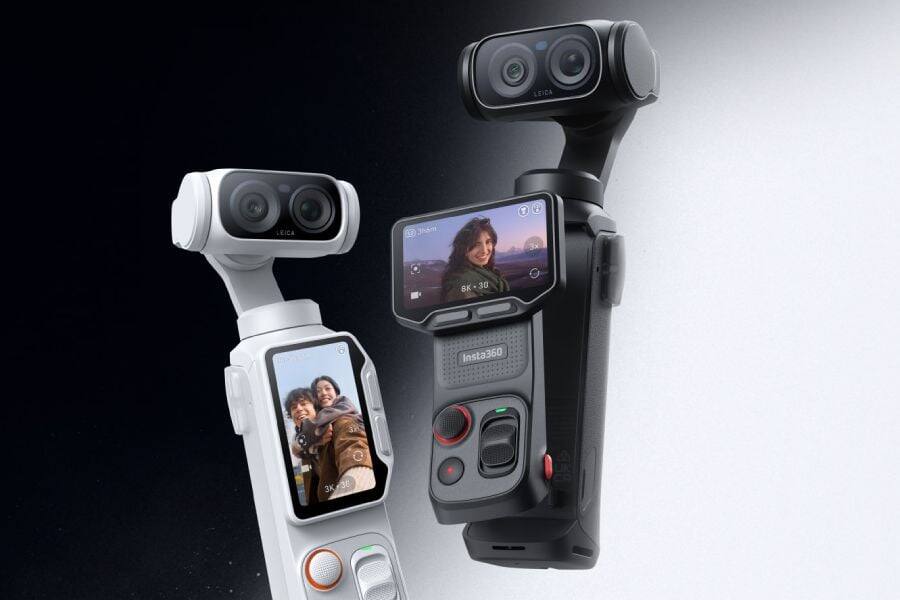
Insta360 has finally turned the Luna Ultra from rumor bait into a real product, and it arrives with the kind of spec sheet that is trying very hard to look like a serious creator tool: dual Leica-branded sensors, 8K video, a three-axis gimbal, and a price that starts at $769 globally. The company’s first flagship gimbal camera built with Leica is clearly aimed at people who want more than a phone and less than a full cinema rig.
The Insta360 Luna Ultra pairs a 50MP Sony LYT-900 1-inch main sensor with a 50MP OV50Q telephoto unit, and that combo gives the camera five focal lengths from wide to 240mm equivalent. For a handheld gimbal camera, that is an ambitious range, and it puts direct pressure on the kind of zoom flexibility creators usually have to build from multiple devices and too much patience.
Dual sensors and Leica Summicron branding
Leica’s role is more than decorative. Both lenses carry Summicron branding, along with Leica colour science, filters, and an exclusive watermark option. The main camera uses an F1.8 aperture and 14 stops of dynamic range, while the telephoto unit runs at F2.0 and supports up to 12x zoom, or 6x lossless zoom.
That zoom range is the tell. Insta360 is not just chasing sharpness; it is chasing the sort of framing flexibility that social video and travel content live on. DJI and other rivals have spent years pushing stabilized cameras into creator territory, but Leica branding and dual 50MP sensors give Insta360 a cleaner marketing hook than ”our gimbal is also nice.”
Insta360 Luna Ultra 8K video and slow motion
Video support is stacked in the obvious places. The Luna Ultra records 8K with Dolby Vision, 4K at 120fps, and 1080p at 240fps, plus a 4K 60fps PureVideo Mode meant to improve detail and brightness in poor light while cutting noise. For post-production, it supports a 10-bit I-Log+ ACES workflow, and DaVinci Resolve natively supports Insta360’s I-Log format.
Adobe Premiere Pro and Final Cut Pro are on the compatibility list too, and built-in timecode makes multi-camera sync less annoying than it has any right to be. That matters because gadget makers love saying ”pro” while leaving the workflow stranded in a proprietary swamp. Insta360 at least seems to understand that creators actually have to edit the stuff.
- 8K recording with Dolby Vision
- 4K at 120fps and 1080p at 240fps
- 4K 60fps PureVideo Mode
- 10-bit I-Log+ ACES workflow
- Built-in timecode for multi-camera sync
Battery life, storage, and creator extras
There is also a practical side to the Luna Ultra, which is helpful because spec sheets alone do not make a camera useful. The 1,550mAh battery is rated for up to four hours of run time, and it can fast charge in about 23 minutes. Internal storage comes in at 47GB, which is enough to keep you shooting without immediately hunting for a card slot or a backup plan.
Insta360 has also packed in a few solo-creator niceties: Deep Track 5.0 for subject tracking, face recognition with adjustable tone and skin smoothing, and a built-in Mini Fill Light for darker scenes. On the still-photo side, it can stitch 200MP panoramic images and shoot 37MP UltraPhoto shots with AI-enhanced detail. That is a lot of help from the camera itself, which is exactly what a one-person setup tends to need.
Insta360 Luna Ultra price and availability
The Luna Ultra costs $769 globally, with regional pricing set at ¥4,358 in China, 119,800 yen in Japan, and 5,599 HKD in Hong Kong. The Chinese figure is especially interesting because Insta360’s CEO had already hinted that local pricing would be lower than overseas levels, and this release confirms that promise without much drama.
- Global: $769
- China: ¥4,358
- Japan: 119,800 yen
- Hong Kong: 5,599 HKD
The launch itself has been a slow burn: teasers appeared in April, renders leaked in May, and pre-orders surfaced at overseas retailers before the official reveal. That kind of staggered rollout is now standard for high-end creator gear, and it usually means the company is trying to turn curiosity into momentum before rivals get a chance to answer. The more interesting question is whether the Luna Ultra’s Leica partnership and dual-sensor setup can justify its premium over more established gimbal-camera options once reviewers get their hands on it.