

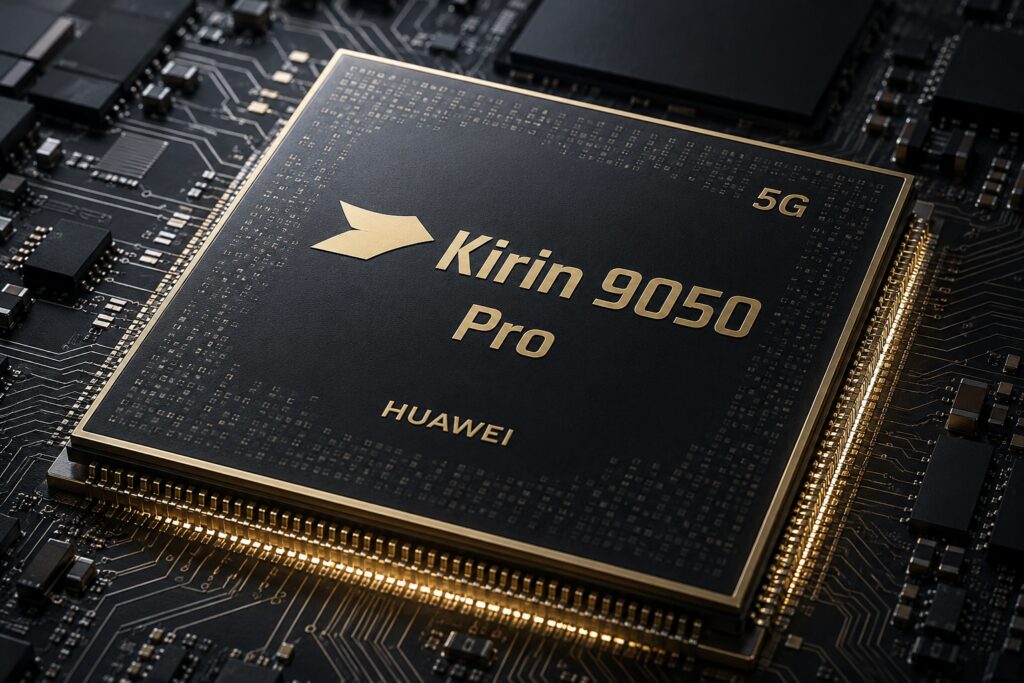
Huawei’s next flagship phones may arrive with a chip that sounds less like a routine upgrade and more like a technical flex. The Huawei Mate 90 series is reportedly tied to a new in-house processor that Huawei says can reach near-3nm-class performance, with early talk pointing to a possible commercial name of Kirin 9050 Pro.
The interesting part is not just the chip name, but the method. Huawei is said to be leaning on a ”Tau” design principle and a logic-stacking approach that focuses on redesigning chip engineering rather than chasing smaller transistor sizes alone. That is a familiar workaround in the semiconductor race: if you cannot always win on pure process shrink, you try to squeeze more out of packaging, layout, and system integration.
Tau design and logic stacking
At the 20th Shenzhen International Financial Expo in China, Huawei executive Zheng Jun reportedly said the new platform is already integrated into the Mate 90 lineup. He described the Tau, or τ, principle as a broader redesign of chip engineering and supply chain coordination, which is a very Huawei way to frame it: part architecture, part industrial choreography, part message to rivals.
According to the claims circulating around the device, the architecture vertically layers key logic circuits instead of relying entirely on geometry shrinks. Huawei reportedly says this boosts transistor density by 53.5 percent, reaching around 238 million transistors per square millimetre.
- Reported transistor density gain: 53.5 percent
- Reported density level: around 238 million transistors per square millimetre
- Reported performance-core power efficiency improvement: 41 percent
- Reported peak clock speed increase: 12.7 percent
Kirin 9050 Pro naming and claimed performance
Huawei has not confirmed the final branding, but recent reports suggest the chip may launch as the Kirin 9050 Pro. If that happens, the naming will matter less than the signal it sends: Huawei wants the Mate 90 to look like a true flagship platform, not a compromise phone built around sanctions-era constraints.
The company is also said to be claiming performance close to Intel’s 18A process and early-generation TSMC 3nm technology. That is a bold comparison, and the kind of benchmark talk that should be read with a raised eyebrow until independent testing shows up. Still, Huawei has spent years trying to build a parallel semiconductor stack, and even partial gains in density and efficiency would be meaningful.
Mate 90 launch timing and AI focus
Beyond the chip, the Huawei Mate 90 series is expected to lean hard into flagship performance and AI features. Leaks point to a debut in September this year, which would put the phone into the thick of the autumn premium-device cycle rather than letting it drift quietly into the calendar.
If Huawei can back up even part of these claims, the Mate 90 could become one of the company’s most attention-grabbing launches in years. The bigger question is whether this is a one-off leap or the start of a more durable cadence, because in smartphones the real victory is not announcing a clever chip once – it is making the next one look almost boring.