

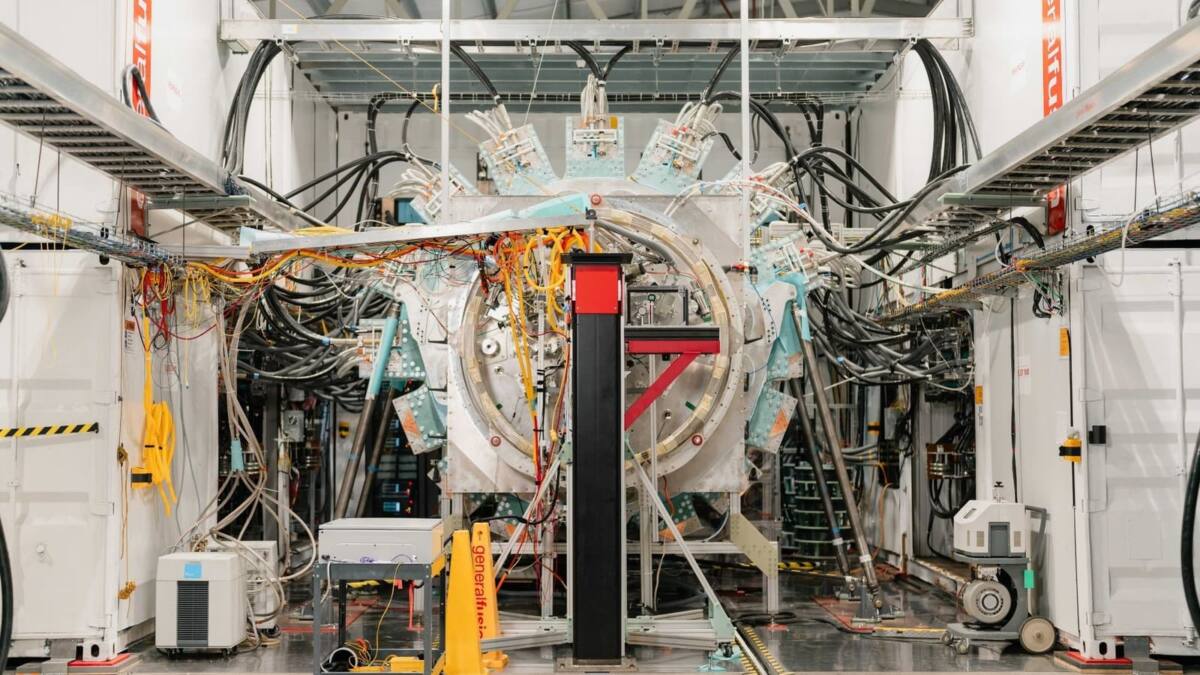
General Fusion says its LM26 experiment has pushed plasma to about 8.4 million C by mechanically compressing it, a result that gives the Canadian fusion company a fresh talking point in a field packed with overpromises and very expensive headaches. The test also showed a roughly tenfold rise in plasma density and a stronger poloidal magnetic field, but the machine is still firmly in the ”promising” bucket, not the ”power plant” one.
The company’s approach is Magnetized Target Fusion, or MTF, which tries to avoid the usual extremes of fusion research. Tokamaks use powerful magnetic fields to cage plasma, while laser systems like the National Ignition Facility blast targets with huge bursts of energy; LM26 instead squeezes plasma with a liquid-lithium shell. It is a neat idea because it swaps some of the complexity of giant magnets and precision lasers for mechanical compression, though fusion history is full of elegant ideas that behaved beautifully right up until the power bill arrived.
What General Fusion says LM26 achieved
According to the company, the latest test more than tripled the plasma temperature to 0.72 keV, while keeping the compression stable and limiting contamination from the lithium lining. That matters, because impurities can cool the plasma and ruin the whole point of the exercise. General Fusion also says it detected a rise in neutron flux during compression, which may indicate that some fusion reactions were taking place.
Temperature was checked using multiple methods, including Thomson scattering and analysis of extreme ultraviolet emission. That kind of cross-checking is a good sign; fusion experiments live and die on measurement quality, and a single sensor can be a liar in a lab coat.
Why the 8.4 million C milestone is still not enough
General Fusion is careful not to oversell the result, and for good reason. The experiment still consumed more energy than it produced, the results have not yet cleared full independent peer review, and the next targets are about 1 keV, then 10 keV, before the company can seriously chase the Lawson criterion for sustained, energy-positive fusion.
- Current result: about 0.72 keV, or roughly 8.4 million C
- Next target: about 1 keV, or roughly 10 million C
- Longer-term target: 10 keV and the Lawson criterion
If LM26 keeps improving without turning the lithium shell into a science-fair disaster, General Fusion could move from ”interesting lab result” to a more credible fusion contender. The bigger question is whether mechanically compressed plasma can scale cleanly enough to matter commercially, or whether it becomes another clever detour on fusion’s very long road.