

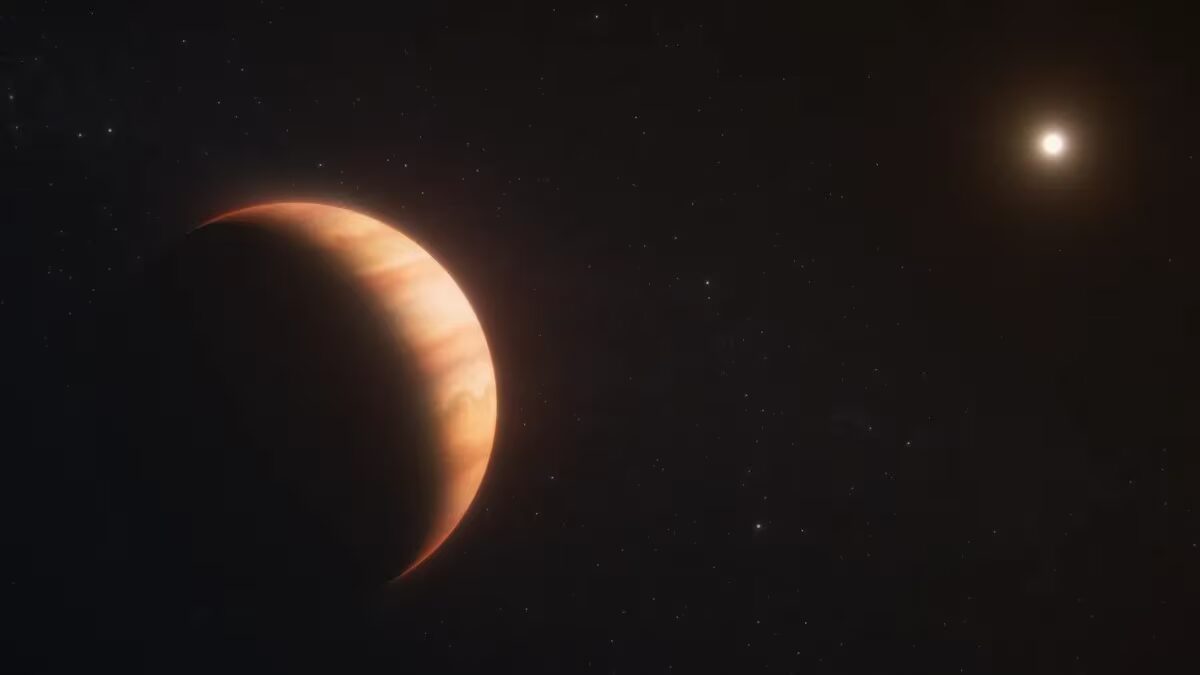
Eighty light-years away, astronomers have spotted a planetary system that defies expectations. The gas giant WD1856b completes an orbit around its white dwarf star in just 1.4 days-a surprisingly tight orbit given the star’s violent past. When this white dwarf was once a red giant, any planet orbiting so close should have been obliterated. Adding to the mystery, WD1856b turns out to be much hotter than models predicted.
WD1856b weighs between four and 11 times the mass of Jupiter, with a radius roughly eight times larger than its host white dwarf. The sight is almost surreal: a tiny, dense stellar remnant orbited by a colossal planet pressed into an orbit razor close. Normally, such close companions don’t survive a star’s expansion into a red giant-inner worlds typically get engulfed and destroyed.
Astronomers are debating two main scenarios to explain WD1856b’s unlikely existence. One suggests the planet somehow survived the red giant phase intact. The other posits the gas giant formed in a more distant orbit and only migrated inward after the star shrank into a white dwarf. This late orbital shift could have been driven by gravitational interactions within a multi-star system, nudging WD1856b closer once stellar activity had stabilized. While less dramatic, the second theory fits better with established dynamics.
New observations from the James Webb Space Telescope reveal WD1856b’s temperature at around 400 K (about 127 °C)-unexpectedly warm for an old gas giant orbiting a dim white dwarf. Starlight alone can’t account for that heat, suggesting the planet may still be cooling down after the energy-intensive migration to its current orbit.
WD1856b has been under the watchful eye of astronomers since 2020, when it emerged as one of the first solid candidates for a giant planet orbiting a white dwarf. Finding such survivors is rare. While damaged asteroids and dusty debris disks are frequently spotted around white dwarfs, intact large planets in tight orbits stand apart. This system holds special interest for understanding the future of planetary systems-about 97% of stars in the Milky Way, including our Sun, will eventually become white dwarfs.
The big question isn’t whether WD1856b exists, but how it ended up in an orbit where, theoretically, it shouldn’t. If late-stage migration brought it inward after the star’s death, astronomers will need to rethink how long planetary systems remain dynamically active post-star demise. If the planet truly survived the red giant engulfment, it presents a cosmic puzzle challenging current stellar and planetary evolution models.