

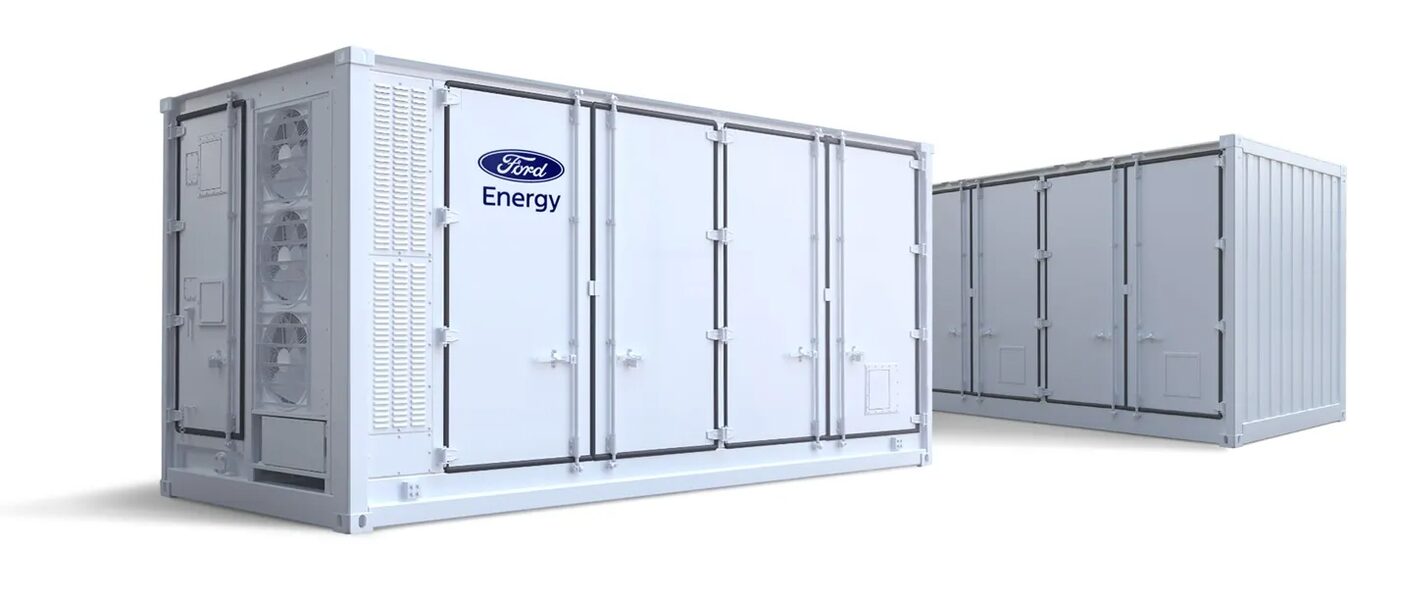
Ford has stepped into grid-scale storage with Ford Energy, a new battery system built to challenge Tesla and other industrial energy players. The pitch is straightforward: pack a lot of storage into a standard 20-foot container, assemble the LFP prismatic cells in the US, and aim for American industrial customers that want fewer logistics headaches and more predictable deployment.
The company says deliveries are planned for the end of 2027, but the price is still under wraps. That leaves Ford in the familiar pre-launch zone where bold hardware announcements are cheap and actual revenue is still somewhere on the horizon. Still, the setup looks serious enough to matter: industrial battery storage is one of the few corners of the energy business where transportation, manufacturing, and utility demand all collide.
Ford Energy specs and deployment
Ford says the system is designed for a range of use cases, from factory support to broader infrastructure projects. The numbers are chunky, and they are exactly the sort of numbers that win procurement meetings:
- Nominal capacity: 5.45 MWh
- Battery module: 512 Ah
- Operating voltage: 1040-1500 V
- Weight: about 43.5 tons
- Cooling: liquid-cooled
- Protection rating: IP55
- Corrosion class: C5
- Operating temperature: -35°C to +55°C
- Operating altitude: up to 4000 meters
- Maximum noise: 75 dB
Why the container format matters
Putting the whole thing inside a standard container is not glamorous, but it is smart. It lowers friction for shipping and installation, and in this market friction is often the difference between a pilot project and a purchase order. Ford is also leaning on US-based cell assembly, which fits the broader push to localize energy hardware instead of shipping critical parts halfway around the world.
The bigger backdrop is obvious: Tesla helped normalize large battery systems, and now automakers and industrial groups are chasing the same demand with their own branded storage products. Ford is late to the party, but late is still useful if you show up with a spec sheet that can survive a harsh site, a noisy substation, and a procurement team that has seen every sales pitch twice.
End of 2027 is the real checkpoint
For now, Ford Energy is a promise, not a product line dominating the field. The real test arrives at the end of 2027, when Ford has to prove that its industrial battery can scale beyond a press release and compete on cost, reliability, and service. If it gets those pieces right, the company may have found a new business that looks a lot less flashy than cars and a lot more durable.