

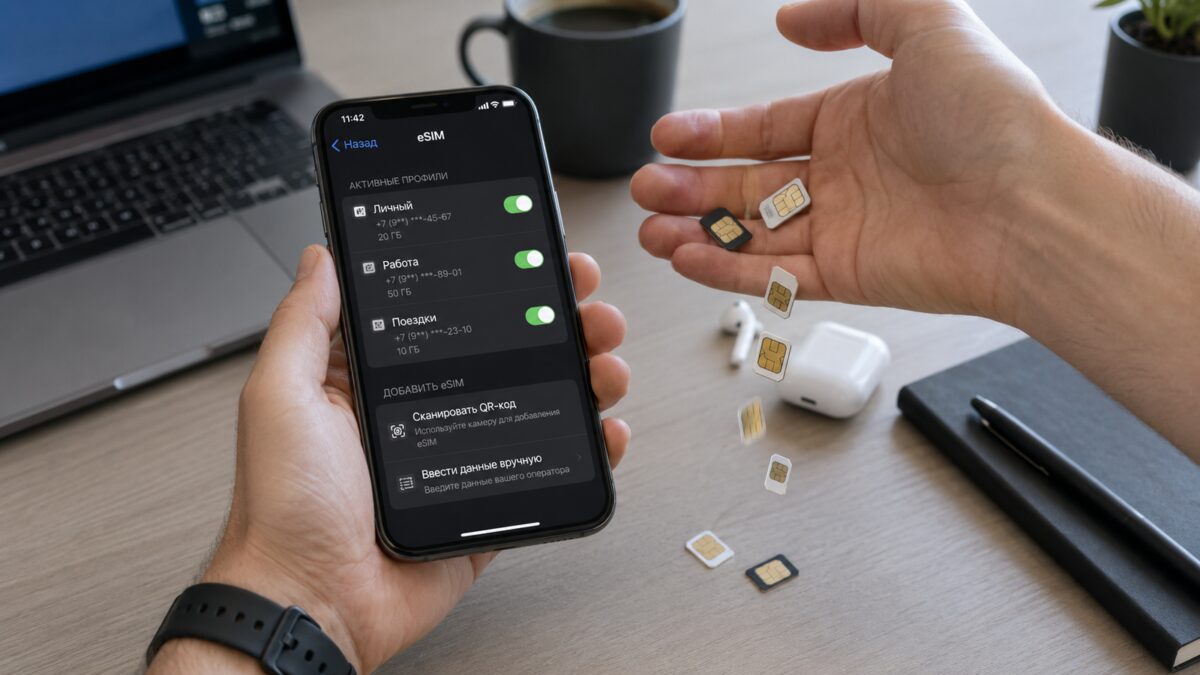
eSIM is quietly turning into something more useful than a digital SIM card clone: a way to juggle personal, work, and travel numbers on one phone. That shift is showing up in Unisimka’s usage data, where more than a third of customers now connect three or more profiles, while just 41% stick to one.
The rest split between two profiles, at 23%, and a growing group that treats the phone as a small communications stack rather than a single-number device. For operators and accessory makers, that is the real story: people are not merely adopting eSIM, they are using it to avoid carrying a second handset, keep business calls separate, and pick local numbers while abroad.
How people are using multiple eSIM profiles
Unisimka says the demand is being driven by practical habits, not novelty. Users are splitting personal and work contacts, adding business lines, switching between tariffs from different operators, and activating local numbers for trips. That lines up with a broader pattern in mobile connectivity: once a feature stops being experimental, people start stacking it for convenience and cost control.
New registrations at Unisimka rose 78% year on year from March to May 2026. April was the standout month, with registrations up 37% from March and 84% higher than a year earlier, suggesting the service is moving beyond early adopters into routine use.
- One profile: 41% of users
- Two profiles: 23%
- Three or more profiles: more than a third
People activate eSIM almost immediately
There is also a nice little clue about buyer behavior. In autumn 2024, around 80% of users activated the module in the first month after purchase; in 2025-2026, that share climbed to 82-89%. In plain English: people are no longer buying eSIM accessories to admire them in a drawer.
That speed matters because it shows the product is solving an immediate problem, not creating a future one. The use case is especially attractive for travelers and freelancers, but the bigger win is for anyone who wants flexibility without replacing a perfectly good phone.
Xiaomi and Samsung lead eSIM activations
The device mix points to another useful truth: most people are extending the life of existing phones rather than buying a new one for built-in eSIM support. Xiaomi and Samsung account for 17% of activations each, followed by Huawei and Realme at 9% each, and Vivo and OnePlus at 6% each. Together, those brands make up about 80% of installations, with many of the popular devices dating from 2021-2022.
That is the kind of adoption curve hardware makers like to see and carriers probably tolerate with mixed feelings. eSIM was sold as a cleaner substitute for the physical card, but the market is now using it as a control panel for multiple identities. Expect that to keep growing as more users decide that one phone can, in fact, have three lives.