

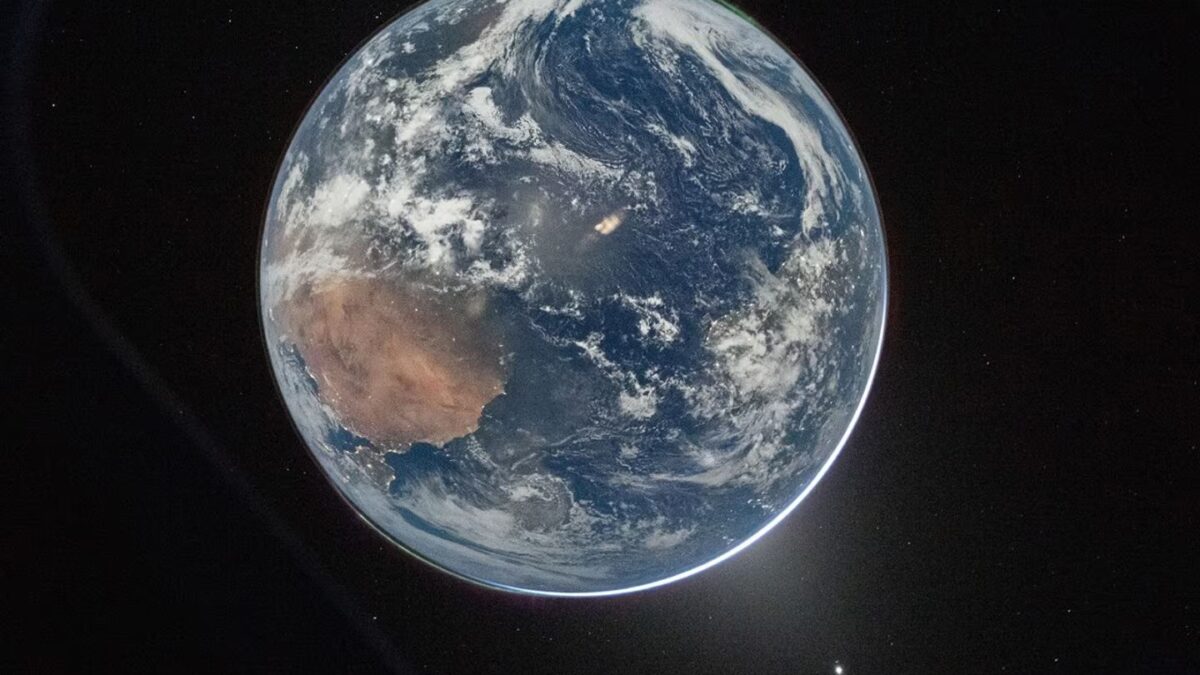
On July 6, Earth will reach aphelion, the farthest point from the Sun in its orbit. At this moment, the distance between our planet and the Sun will stretch to about 152.1 million kilometers, while Earth’s orbital speed will drop to its slowest pace in 2026, according to Moscow Planetarium via TASS.
That day, Earth will orbit the Sun at roughly 29.27 to 29.29 kilometers per second. By comparison, during perihelion-the closest point to the Sun in January-our planet zips along at around 30.27 to 30.29 km/s. While this difference seems minor to everyday observers, it is perfectly normal in celestial mechanics because Earth’s orbit is elliptical.
Aphelion also affects another subtle phenomenon: the Sun appears smallest in the sky on July 6. This is explained by Kepler’s second law, which states that a planet moves faster when near the Sun and slower when farther away, causing the apparent size of the Sun to fluctuate throughout the year.
For context, Earth’s elliptical orbit and the resulting speed changes are a shared feature among planets orbiting stars. Compared to planets like Mercury, which has a highly eccentric orbit, Earth’s orbit is relatively close to circular, causing only modest variations in orbital speed and solar appearance throughout the year.
With aphelion approaching, it is a timely reminder of how dynamic and finely balanced our cosmic neighborhood is. NASA and other space agencies continue to study Earth’s orbit and its effects on climate and solar radiation. Tracking events like aphelion remains important for both astronomy and Earth sciences.