

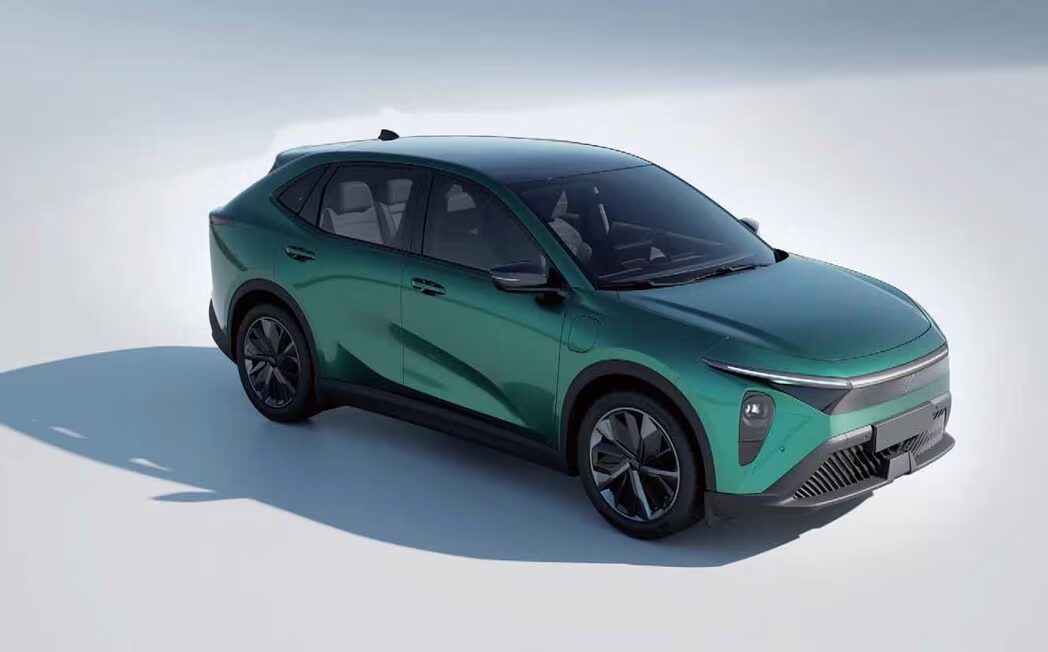
Engineers at Russia’s ATOM research center-run by automaker Kama-have been spotted working on a Chinese electric crossover prototype, the Launch EV One. A photo shared by Russian auto magazine TAGAZ shows the EV One parked not at a showroom but inside ATOM’s own engineering facilities. While this doesn’t mean ATOM is ditching its original hatchback design, it raises questions about whether Kama is exploring new platforms or aiming to quickly launch an SUV variant using an existing Chinese base.
ATOM was introduced as a compact urban hatchback measuring 3,995 mm long, equipped with rear-wheel drive, a nickel-cobalt-manganese (NCM) battery pack, and up to 500 km of range. The Launch EV One, by contrast, is a noticeably larger crossover-roughly 300-600 mm longer-with front-wheel drive and a lithium iron phosphate (LFP) battery. LFP cells usually cost less but offer lower energy density compared to NCM chemistry.
Shanghai Launch Automotive Technology, the Chinese company behind the EV One, provides integrated platforms rather than standalone engineering services or software. They deliver a complete chassis along with an assembled vehicle that partners can rebrand and produce. This turnkey approach speeds up market entry for emerging brands by bypassing years of platform development, expensive crash testing, and building localized manufacturing chains.
Kama’s collaboration with the Chinese side isn’t new. Back in 2023, a delegation from Tatarstan visited Launch Design in China, although it wasn’t initially about adopting the ATOM’s design. Such partnerships are common in Russia’s fledgling electric vehicle scene: brands like Evolute and the electric Moskvich 3e have similarly launched models based on Chinese platforms paired with local branding. The Russian EV market remains small-just over 17,000 new electric vehicles were sold nationwide in 2024, according to AutoStat.
There’s been no official word from Kama yet, leaving room for speculation. This could be a routine technical assessment of foreign designs, a step towards launching an SUV for the domestic market, or even preparation for an export model based on the Chinese EV One. If the project moves beyond internal testing, evidence will likely surface through patents, certification filings, or formal public unveilings-probably without the current hush surrounding it.
Differences between ATOM hatchback and Launch EV One crossover
- ATOM hatchback length: 3,995 mm
- Launch EV One length: approximately 4,295-4,595 mm
- ATOM hatchback drivetrain: rear-wheel drive
- Launch EV One drivetrain: front-wheel drive
- ATOM battery type: nickel-cobalt-manganese (NCM)
- Launch EV One battery type: lithium iron phosphate (LFP)
- ATOM range: up to 500 km
- Launch EV One offers generally lower energy density batteries but potentially lower cost
Compared to major electric vehicle players like Tesla, Volkswagen, or Hyundai, Russia’s ATOM project remains niche with a focus on affordable, compact vehicles tailored for local conditions. Integrating a Chinese crossover platform might offer Kama a shortcut into the rapidly growing global SUV segment without the long lead times typical for ground-up development.
The key challenge will be whether Kama can adapt the Chinese technology to meet Russian standards and consumer demands while carving out its own brand identity.
Watch for upcoming patent applications or certification papers to see if Kama officially expands beyond the hatchback with a crossover variant-and whether this signals greater reliance on Chinese EV platforms in Russia’s developing electric vehicle industry.