

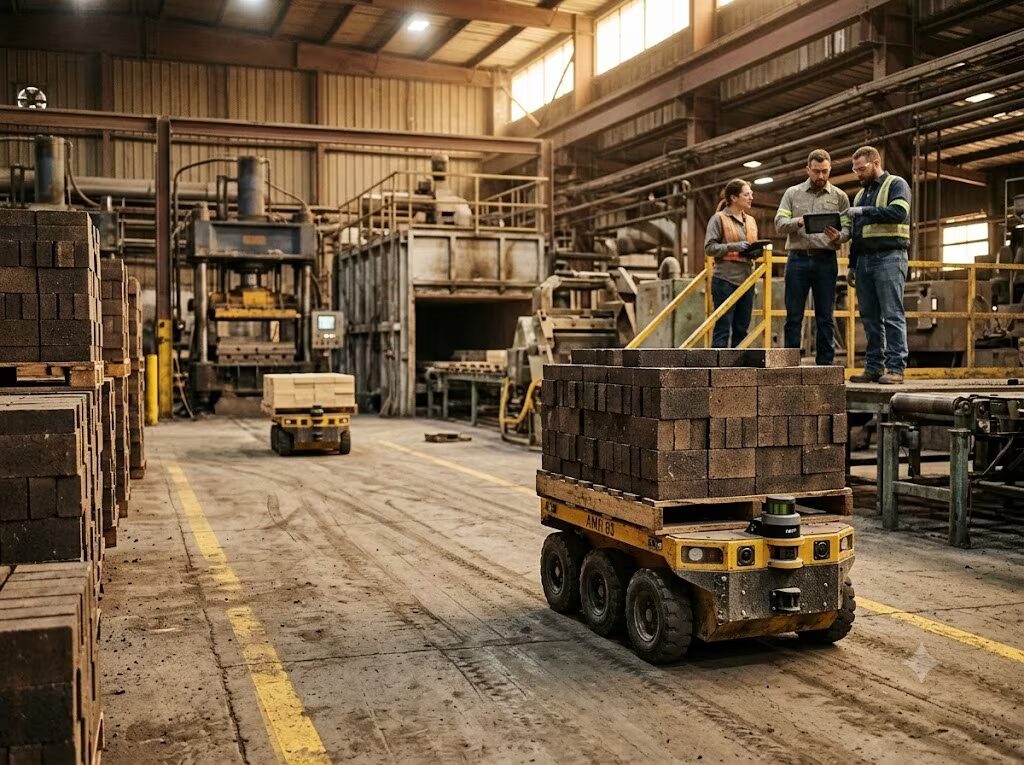
Researchers at South Ural State University (SUSU) have proposed using autonomous mobile robots (AMRs) to handle heavy internal logistics at refractory factories in Russia. These machines would take over the labor-intensive task of transporting pallets of bricks and bulk materials between workshops-a job currently done by human workers. If implemented, this could reduce workplace injuries, product damage during transport, and dependency on manual labor.
Unlike traditional automated guided vehicles (AGVs) that follow fixed rails or tracks, SUSU’s AMRs navigate more flexibly. They generate their own paths, detect and avoid obstacles dynamically, and can adapt to route changes simply by updating a digital map of the facility. This adaptability is crucial for refractory plants, where dusty, harsh conditions and fluctuating temperatures make rigid infrastructure costly and impractical to maintain or modify.
Refractory factories operate in tough environments filled with dust and heavy loads, unlike the clean, controlled warehouses often featured in robotics demos. The researchers studied a typical site and concluded that flexible AMRs outperform classic automated carts in these settings. Frequent layout changes on such industrial sites are expensive and often require halting operations, so robots that can adapt without physical reconfiguration are a big advantage.
Technical requirements for AMRs in refractory factories
- Carry loads up to 1.5 tons
- At least IP54 dust protection
- Positioning accuracy within 10 mm
- Operate at least eight hours on a single charge
The team also developed a mathematical model to estimate how many robots a given workshop would need. For example, to transport pallets of bricks from the pressing hall to drying chambers, the calculation calls for six AMRs.
Financial outlook and deployment plan for autonomous robots
Financially, the project’s payback will take six to nine years, factoring in reduced downtime, fewer defects, and labor cost savings. Deployment is planned in stages, starting with a pilot involving two or three robots, followed by a scale-up integrated into the factory’s management systems.
Global trends in industrial mobile robots
Interest in autonomous mobile robots is growing globally. The International Federation of Robotics reported that around 541,000 industrial robots were installed worldwide in 2023, with the internal logistics segment among the fastest expanding. Amazon’s extensive use of mobile robots in warehouses stands out as a prominent example, although refractory production demands more rugged designs optimized for dusty environments and heavy loads rather than top speed.
Future plans: digital twin simulation for robotic logistics
Next, SUSU researchers plan to create a digital twin of a Magnezit refractory plant-a leading Russian manufacturer-to simulate robot routes, workload, and bottlenecks before actual rollout. This virtual model will help determine whether Russia’s heavy industry is ready to shift from carts and forklifts to smarter, autonomous logistics robots.