

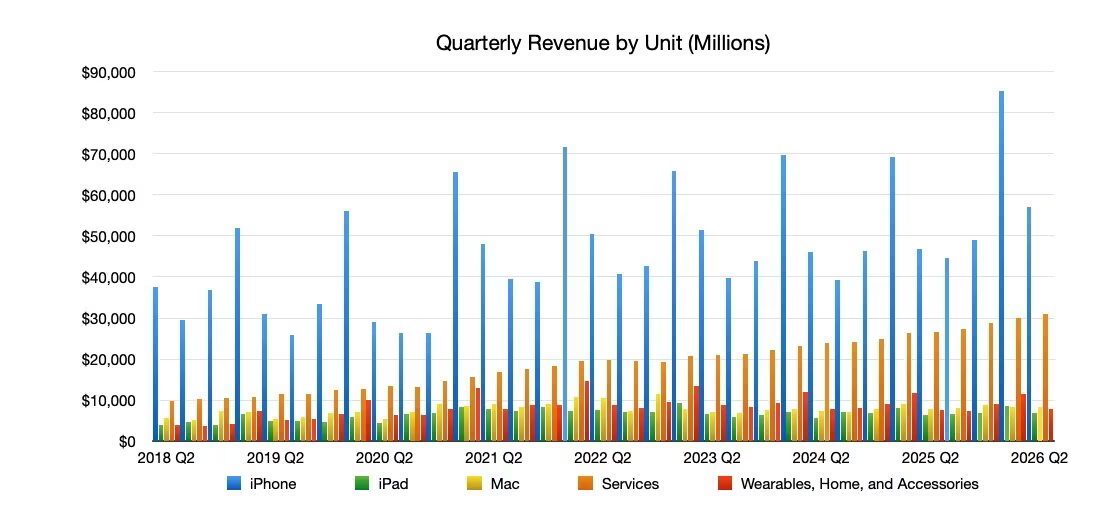
Apple will release its financial results for the third quarter of fiscal 2026 on July 30. On the same day, CEO Tim Cook and CFO Kevan Parekh will host a conference call with investors. This report is pivotal not only due to Apple’s forecasted revenue surpassing $100 billion but also because of the anticipated leadership transition planned for later this year.
Last quarter, Parekh projected a 14-17% year-over-year revenue increase. If those estimates hold, Apple’s quarterly revenue could range from $107.2 billion to around $110 billion, up from $94 billion in the same period last year. This would be an unusually strong performance for Apple’s June quarter, which historically lags behind the holiday season that usually drives its highest sales.
The company also forecasted a gross margin between 47.5% and 48.5%, with operating expenses expected to land between $18.8 billion and $19.1 billion. Investors will be keenly focused on whether Apple can maintain its margins following the June price hikes-particularly since this quarter lacks a major new iPhone launch. According to insiders, the mix of pricing strategy, product lineup, and growth in services will dominate the earnings call discussion.
While this quarter saw relatively few headline-grabbing product launches, the arrival of AirPods Max 2 stands out, although it’s unlikely to significantly move overall revenue. More notably, this report will fully reflect the retail sales of devices unveiled earlier this year in March and released closer to the end of the prior quarter.
- iPad Air with M4 chip
- MacBook Neo
- MacBook Air with M5 chip
- MacBook Pro with M5 Pro and M5 Max
- Updated Apple Studio Display
- Apple Studio Display XDR
- iPhone 17e
Apple Q3 2026 report and recent price hikes
The July 30 report may be one of Tim Cook’s last earnings calls as CEO. Apple has previously announced that John Ternus will succeed Cook as CEO, with the formal transition expected before the October earnings. Investors will likely probe not just the quarterly numbers but also how Apple plans to navigate this leadership change without altering its strategic trajectory.
This will mark Cook’s 90th quarterly earnings call, a milestone that might have gone unnoticed in any other year. Given the timing alongside the leadership handover at the helm of the world’s most valuable public tech company, the call carries additional symbolic weight in the market.
Another prominent topic beyond the raw financials will be the price increases introduced in June. Cook had indicated prior to the price revisions that rising memory costs had rendered Apple’s previous pricing ”unsustainable.” Shortly after, Apple raised prices across nearly its entire lineup-though iPhone prices remained unchanged at that time.
Highlights of the price changes include:
- MacBook Air models increased by several hundred dollars, depending on configuration
- Base MacBook Pro up about $300
- iMac prices rose by roughly $200
- Mac Studio saw the sharpest jump: M4 Max model went from $1,999 to $2,499, M3 Ultra jumped from $3,999 to $5,299
- Apple Vision Pro increased by $200
- HomePod mini rose by $30
These hikes matter for the June quarter for two main reasons. First, some of the price increases took effect near the quarter’s end, potentially boosting revenue ahead of the new price points. Second, the market will scrutinize how successfully Apple passes higher costs onto customers without denting demand, especially for Macs and wearables where upgrade cycles are longer than for smartphones.
The iPhone lineup will also attract close attention. With the iPhone 18 family launching this fall, analysts will be hunting for clues about Apple’s future pricing strategy. While iPhones still generate the majority of Apple’s revenue, the fastest growth recently has come from services-which now contribute over $25 billion per quarter and help sustain overall margins.
If Apple hits the upper end of its revenue guidance, it will set a new record for its third fiscal quarter. The July 30 report will answer whether June’s price hike was a one-off or the start of a new pricing approach. The definitive test will come this fall alongside the release of the iPhone 18 and the first earnings report under John Ternus’s leadership.
Apple’s Q3 results arrive at an inflection point. The company faces a rare leadership handoff while navigating higher costs and shifting consumer demand. How Apple balances price increases with growth in a saturated smartphone market-and whether its expanding services business can offset pressure on device sales-will set the tone for the tech giant’s next chapter.