

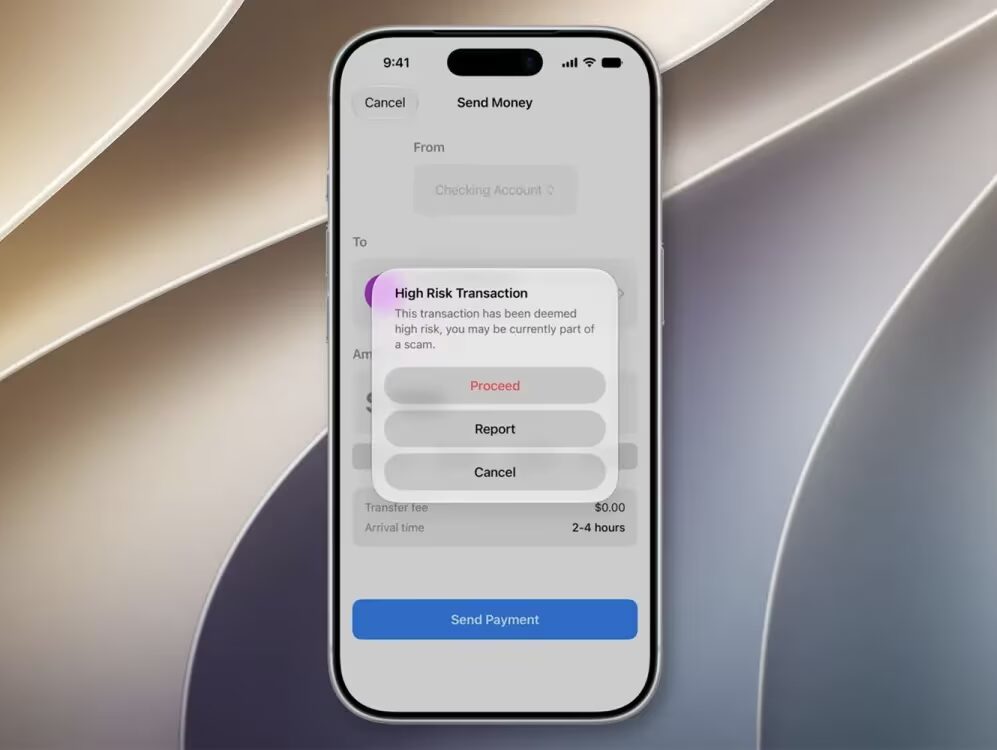
Apple is rolling out a new anti-fraud feature in iOS 27 called Trust Insights, designed to help apps detect when users are being manipulated by social engineering scams. Instead of analyzing message content or photos, the system monitors behavioral patterns-like timing, interaction sequences, and sensor data-to assess the risk that a user is acting under coercion from scammers. The risk signals are generated directly on the device and sent to apps, which can then trigger safeguards.
Social engineering attacks don’t rely on technical hacks but on convincing victims to carry out actions themselves, such as transferring money, changing security settings, or sending sensitive documents. Trust Insights looks for unusual behavioral signatures indicating a user might be following a scammer’s instructions, assigning operations a medium or high-risk score accordingly.
Apps can respond to these risk signals by activating tailored security measures-these are developer tools integrated within their own fraud prevention flows, not OS-level blocks. Options include:
- Displaying warning prompts before critical actions
- Adding delays on transfers or data submissions
- Requiring extra confirmations
- Feeding risk data into the app’s existing moderation systems
Apple emphasizes that raw behavioral data is deleted immediately after processing; only the final risk score is shared with Apple servers, where it can be cross-checked against Apple Account information and signs of suspicious activity. Users can disable Trust Insights anytime in their device settings.
At launch, Trust Insights will monitor five categories of actions: payments and transfers; account data and security setting changes; use of costly resources like AI queries; sending messages, documents, and forms; and other operations that don’t fit specific categories. Apple encourages developers to provide feedback on how well the system helps block scams and report confirmed fraud cases.
This feature reflects Apple’s expansion into anti-fraud technology already explored by Google and financial institutions. Google has been enhancing its on-device Scam Detection for Phone and Messages on Android through 2024 and 2025, focusing on call and message analysis. Apple’s Trust Insights offers a more universal risk assessment layer across third-party apps, potentially capturing a wider range of scam scenarios.
The timing addresses the growing scale of social engineering fraud: according to the US Federal Trade Commission, consumer losses due to fraud surpassed $12.5 billion in 2024, with a sizable portion caused by social engineering rather than traditional hacking. Apple’s Trust Insights aims to help users identify and halt these threats directly on their devices before damage occurs.
As Apple integrates Trust Insights into iOS 27, the key challenge will be balancing proactive scam prevention with user privacy and minimizing false alarms that could frustrate users or developers. The effectiveness and adoption of this behavioral analysis framework by third-party apps will be closely watched as social engineering tactics grow more sophisticated.