

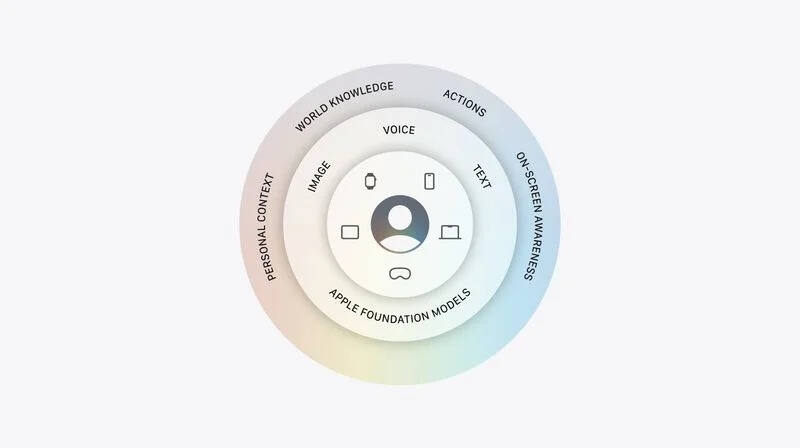
Apple has overhauled Apple Intelligence with a new architecture built on base models developed alongside Google, tapping into the technology behind the Gemini family. The move gives Apple a faster path to stronger reasoning, multimodal features, and image generation, while also making its AI stack look a lot less homegrown than the company would probably like to admit.
The company says the rebuilt Apple Intelligence system runs both on-device and on remote servers through its private cloud infrastructure. Apple is pitching that as a privacy-preserving way to deliver more capable AI without turning user data into training fuel for everyone else.
What Apple says the new Apple Intelligence models can do
The updated Apple Intelligence models add a wider set of tools, including realistic image creation, more advanced photo editing, and visual answers to questions. Apple also says some eligible devices will get a higher-end version with speech generation, more accurate dictation, and better natural-language understanding, though it did not say which devices qualify.
- Realistic image generation
- Expanded photo editing
- Visual answers to questions
- Speech generation on higher-end devices
- Improved dictation accuracy
- Better natural-language understanding
A system orchestrator sits at the center
Apple says a new ”system orchestrator” now coordinates Apple Intelligence across its platforms and adjusts behavior based on the active app and the user’s task. That is the sort of phrasing Apple tends to use when it wants the assistant to sound deeply integrated rather than bolted on, and in this case the ambition is clear: a genuinely system-wide AI layer instead of a feature that only wakes up in a few apps.
The privacy pitch stays intact, at least on paper. Apple says user data is used only for the current request and is not accessible to Apple or third parties, and it adds that outside experts can verify those claims at any time. That is a direct answer to the obvious fear here: if Apple is leaning on a major outside partner for its AI core, trust becomes part of the product.
Apple’s AI reset looks overdue
The backdrop matters. Rivals have spent the past stretch iterating quickly on chat, image, voice, and multimodal features, while Apple Intelligence has been widely seen as more cautious than cutting-edge. By anchoring the rebuild to Gemini-era model tech, Apple is effectively admitting that the first version was not enough for the pace of the market.
The unanswered question is not whether Apple can ship a smarter assistant. It is whether it can do so without blurring the line between Apple’s privacy-first brand and the reality that the company is now borrowing heavily from a partner that is also one of its biggest competitors.