

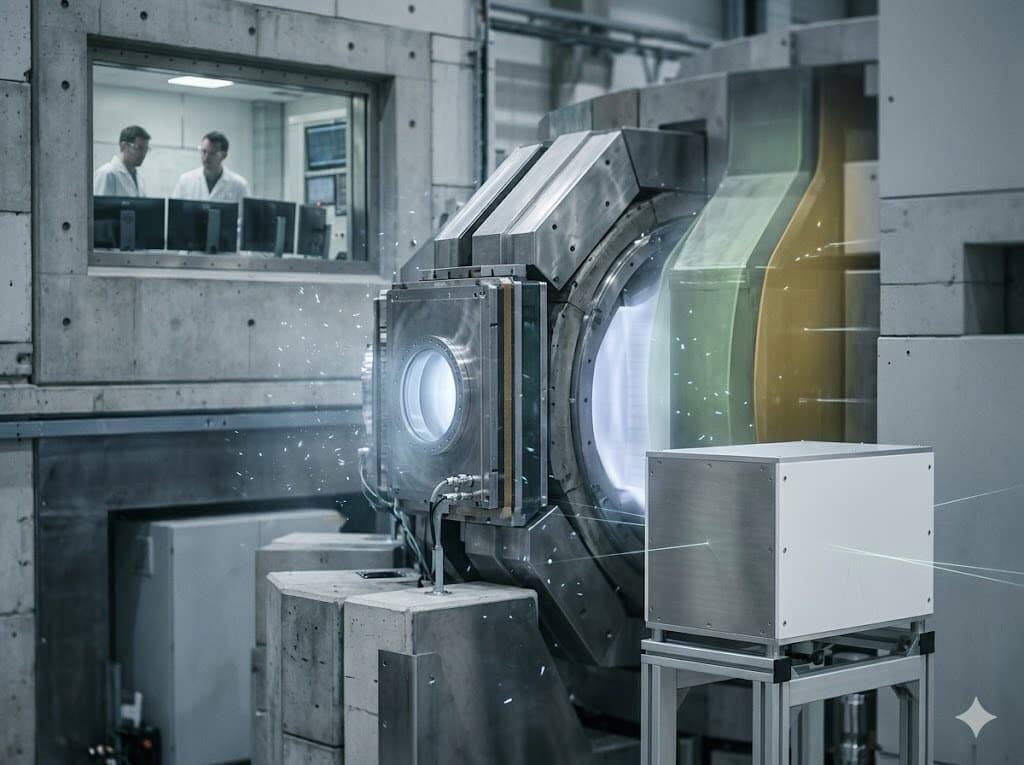
A compact antineutrino detector may be enough to spot secret plutonium-239 production inside a fusion reactor, according to researchers from Virginia Tech. In their model, a one-ton detector could identify several kilograms of plutonium-239 in 30 days, even if the reactor is wrapped in concrete and steel and never opened for inspection.
That matters because fusion has a clean reputation to protect. A deuterium-tritium reactor does not rely on weapons-grade fuel the way fission plants do, but the neutron flood it creates can be used for something far less wholesome: converting uranium-238 into plutonium-239 inside the blanket around the plasma. The study is a reminder that ”clean” and ”nonproliferation-proof” are not the same thing.
How antineutrino detectors could track plutonium production
The researchers looked at blanket designs that are already part of serious fusion engineering plans, including FLiBe molten-salt systems and dual-coolant lithium-lead concepts. Those choices matter because they change how neutrons behave, how materials activate, and how messy the background signal becomes. In other words, the reactor design itself can either hide or reveal suspicious isotope production.
The core trick is simple physics. Heavy nuclei fissioning in the reactor, including material created from uranium-238 activation, emit a distinctive antineutrino signature. Since antineutrinos cannot be shielded away, the detector watches for that signature from outside the building, without touching the machine or interrupting operation.
What the detector would need to see
- Detector mass: about one ton
- Detection method: inverse beta decay
- Threshold energy: 1,806 MeV
- Observation time: 30 days
- Hidden plutonium amount: several kilograms of plutonium-239
That is a compact setup by nuclear-safeguards standards, and it is a sign of where the field is heading. As fusion moves from lab-scale experiments toward commercial plant designs, the security conversation is shifting from ”Can it work?” to ”Can anyone prove it is doing only what it claims?”
Why fusion safeguards are becoming a design issue
The authors argue that future monitoring systems could be built into reactors from the start, rather than added later as an afterthought. That is a familiar pattern in nuclear engineering: once deployment becomes plausible, oversight tools tend to arrive just in time to discover that retrofits are annoying and expensive.
If the model holds up, antineutrino monitoring could become a quiet but useful check on declared civilian operation. The open question is whether regulators and reactor designers will treat this as a niche safeguards idea or as a standard feature of the first commercial fusion plants.