

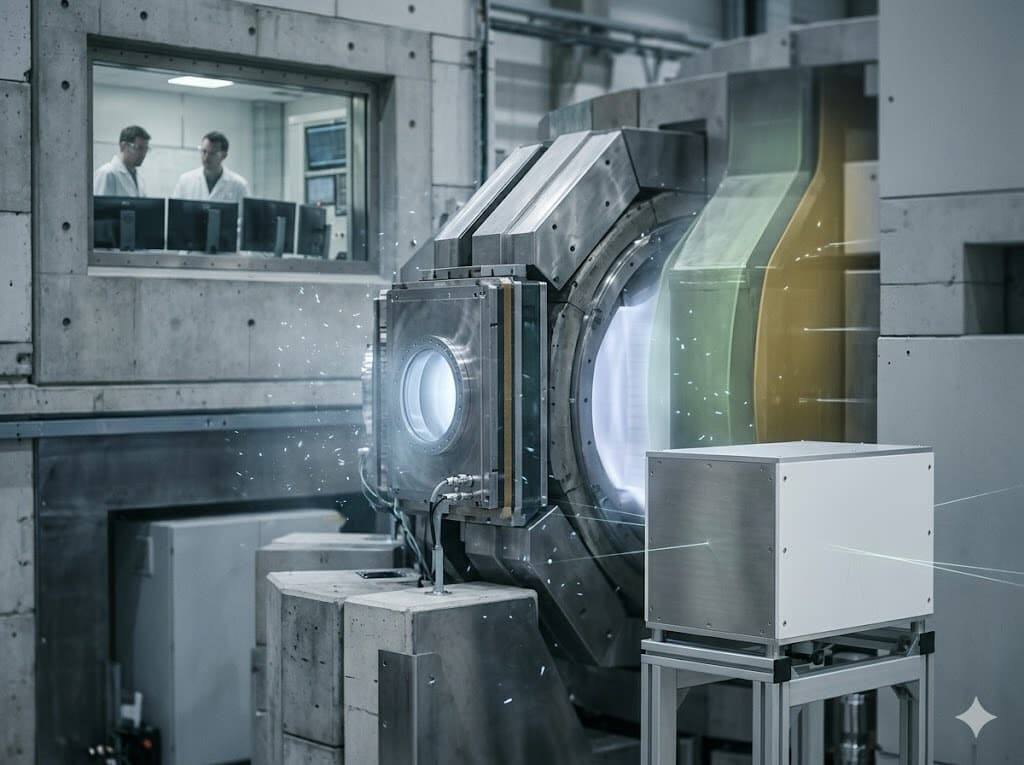
A compact antineutrino detector may be enough to spot covert plutonium-239 production inside a fusion reactor within 30 days, according to researchers from Virginia Tech. The idea is simple and a little unnerving: the same neutron flows that make a deuterium-tritium reactor useful for power can also be turned, quietly, into a signal that reveals whether someone has been feeding uranium-238 into the blanket.
That makes the study more than a physics exercise. As fusion moves from lab machines toward commercial plants, nonproliferation suddenly has to keep up with engineering, and the old assumption that fusion is automatically ”clean” from a safeguards point of view looks increasingly optimistic.
How antineutrino detectors would work
The proposal relies on antineutrinos, nearly massless, chargeless particles produced in nuclear reactions and impossible to shield. The team modeled a toroidal reactor with a large radius of 6.2 m, a small radius of 2.0 m, and thermal power of about 1500 MW, then tested whether the antineutrino ”fingerprint” from plutonium-related fission could be separated from ordinary reactor activity and natural background.
The detector itself is modest by nuclear-industry standards: about one ton, using inverse beta decay with a threshold of 1.806 MeV. That is the sort of hardware that can sit outside the reactor building and still see through tens of meters of concrete and steel, which is exactly the sort of inconvenience proliferators dislike.
Blanket designs change the antineutrino signal
The paper looks at two blanket architectures in particular: molten-salt FLiBe, with Li-6 enrichment to about 20%, and a dual-coolant lithium-lead design, or DCLL, where lithium enrichment can reach 90%. Those choices matter because they change neutron transport, secondary reactions, and the activation background that can muddy the measurement.
Not every byproduct helps an inspector. Some activation products, especially those that decay through electron capture, barely show up in inverse beta decay detectors at all, while lighter isotopes in lithium-based systems can still be statistically separated with enough observation time. That is the kind of detail safeguards people care about, and reactor vendors would rather keep in a footnote.
What antineutrino detectors mean for fusion oversight
The bigger point is that fusion plants may need monitoring baked in from the start, not bolted on later. If future commercial reactors are expected to operate under international inspection regimes, the ability to verify declared fuel use without opening the machine becomes a selling point, not an afterthought.
That also puts fusion in an awkward but healthy position compared with earlier nuclear optimism: the technology is still being designed, so the safeguards can be designed with it. The likely next step is not a single magic detector, but a layered system of site monitoring, reactor modeling, and policy rules that treat antineutrino counting as a standard compliance tool.
If that happens, the question is no longer whether hidden plutonium production can be detected. It is whether the industry wants to prove its innocence continuously, or wait until regulators ask for the receipts.