

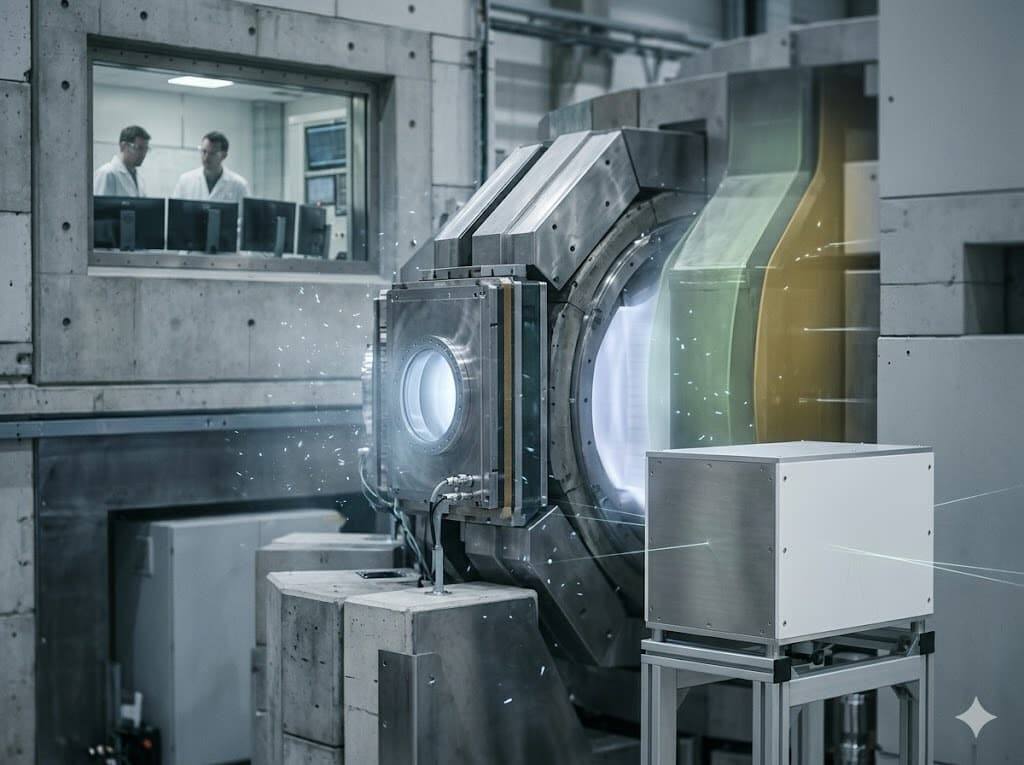
A compact antineutrino detector could help catch a much less glamorous use for future fusion reactors: secretly producing plutonium-239. Researchers from Virginia Tech say a one-ton instrument may be able to spot a few kilograms of the material in 30 days, even if the detector sits outside the reactor building. That is a neat trick, and a mildly unsettling one for anyone betting fusion automatically equals proliferation-proof.
The idea targets deuterium-tritium fusion reactors, which are expected to produce intense 14.1 MeV neutron streams. Those neutrons are the whole point of the machine, but they also create a path for uranium-238 to absorb radiation and transform into plutonium-239, one of the core ingredients for nuclear weapons. In other words: the same physics that helps make electricity can also help hide a materials program, if someone tries hard enough.
How the antineutrino detector would work
Antineutrinos are almost absurdly elusive particles. They have no electric charge, extremely small mass, and are produced in nuclear reactions, which makes them useful as an external signature of what is happening inside a reactor. Because they cannot be shielded in any practical sense, they are a rare case where the laws of physics do the snooping for you.
The team modeled a toroidal fusion system with a large radius of 6.2 m, a small radius of 2.0 m, and a thermal power of about 1500 MW. Using Monte Carlo methods and nuclear reaction data, they looked at two blanket designs:
- FLiBe: a lithium-beryllium molten-salt mix with Li-6 enrichment to about 20%
- Dual-coolant lithium-lead setup: lithium enrichment can reach 90%
- Detection method: inverse beta decay, with a threshold of 1,806 MeV
- Detector size: around one ton
- Detection window: 30 days
- Target signal: production of several kilograms of plutonium-239
Why fusion does not automatically solve safeguards
Fusion still has a cleaner nonproliferation profile than conventional fission reactors, which rely on existing weapons-relevant materials. But the report makes a blunt point: once a high-neutron environment exists, blanket materials can be turned into a covert production channel. The difference between a power plant and a suspect facility may come down to whether anyone is watching the antineutrino output.
That monitoring could matter well before the first commercial reactors are connected to a grid. The fusion industry is moving from lab-scale experiments toward plant design, and safeguards are easiest to build in before hardware gets too fixed and too expensive to alter. Once a reactor is operating, retrofitting trust is usually harder than retrofitting steel.
A reactor can be monitored without opening it
The strongest part of the proposal is its noninvasive nature. The detector could sit outside a reactor building and still track changes through tens of meters of concrete and steel, which is exactly the sort of quiet oversight international inspectors tend to like. The study also argues that background effects from activation products can be separated well enough, especially because some isotopes contribute little or nothing to the inverse beta decay signal.
That leaves a fairly elegant, if slightly unnerving, future: a fusion plant whose declared fuel cycle is checked not by opening panels or sampling hardware, but by reading the particle emissions it cannot hide. If commercial fusion arrives on the current timeline, expect safeguards like this to move from academic curiosity to procurement checklist very quickly.