

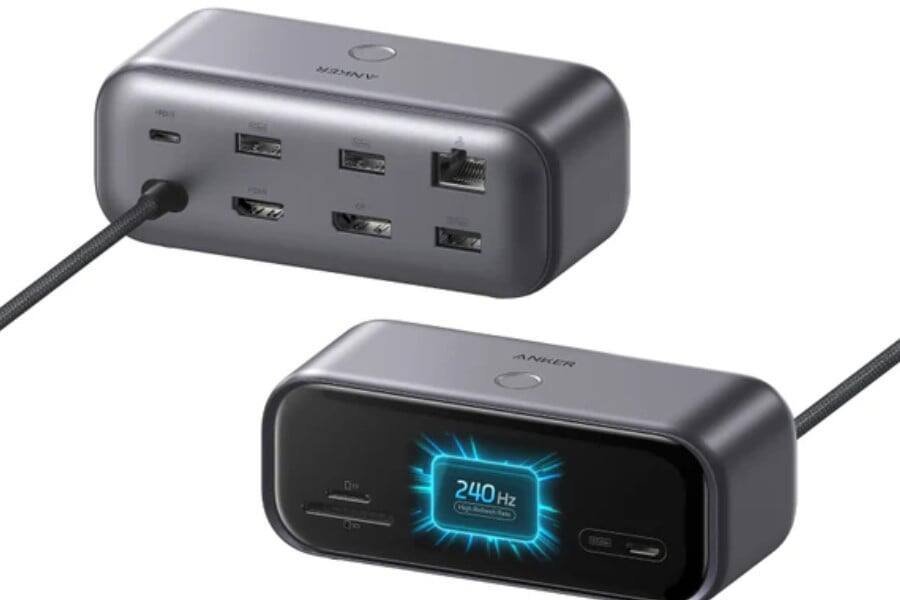
Anker is taking one of the least glamorous accessories in tech and giving it a tiny twist of theatre. Its upcoming Nano USB-C Hub (10-in-1, 240Hz, Display) packs a built-in screen that shows live device activity, plus a fairly serious port lineup, and it is set to launch in Japan in fall 2026 for ¥16,990, or roughly $110.
The Anker USB-C hub connects over a single USB-C cable and offers 10 ports, including 100W USB-C power delivery, HDMI 2.1, DisplayPort 1.4, Gigabit Ethernet, SD and microSD readers, and multiple USB-A ports. That makes it a stronger desk dock than a casual travel add-on, despite the modest ”Nano” branding doing its best impression of optimism.
Anker Nano USB-C Hub ports and display output
On the front, the hub includes a USB-C data port rated up to 10Gbps, alongside full-size SD and microSD card slots. Around back, the layout is more ambitious: one USB-C charging port with up to 100W power delivery, one 10Gbps USB-A port, two 5Gbps USB-A ports, HDMI 2.1, DisplayPort 1.4, and a Gigabit Ethernet jack.
- 10 total ports
- USB-C data: up to 10Gbps
- USB-C charging: up to 100W
- HDMI 2.1 and DisplayPort 1.4
- 4K at 144Hz over both video outputs
What the 240Hz screen actually does
The oddest and most interesting part is the tiny display built into the hub. It shows real-time usage information, and Anker says a companion app can surface more detail. That kind of status panel is more useful than yet another decorative light bar, though 240Hz on a screen that mainly displays numbers is peak ”because we can” engineering.
For Anker, this is also a neat way to differentiate a category that usually competes on the same boring checklist of ports and wattage. Belkin, Ugreen, and other accessory brands have spent years cramming more sockets into compact docks; Anker is betting that visibility is the new premium feature.
Size, colors and the desktop-only vibe
The hub measures about 130 × 56 × 50mm and weighs around 300g, so this is not the sort of thing you casually toss into a sleeve with your charger and forget about. It comes in Dark Gray and Silver, which is about as daring as peripheral design usually gets, and it looks more like a permanent desk companion than a travel gadget.
If the launch stays on schedule, the more interesting question is not whether the hub has enough ports. It does. The real test is whether buyers want a status screen badly enough to pay for one, or whether they will decide that a USB-C hub is still just a USB-C hub, no matter how smooth the numbers look.